What actually happened in the week of 16 November.
Three things landed within four days of each other, and they point the same way.
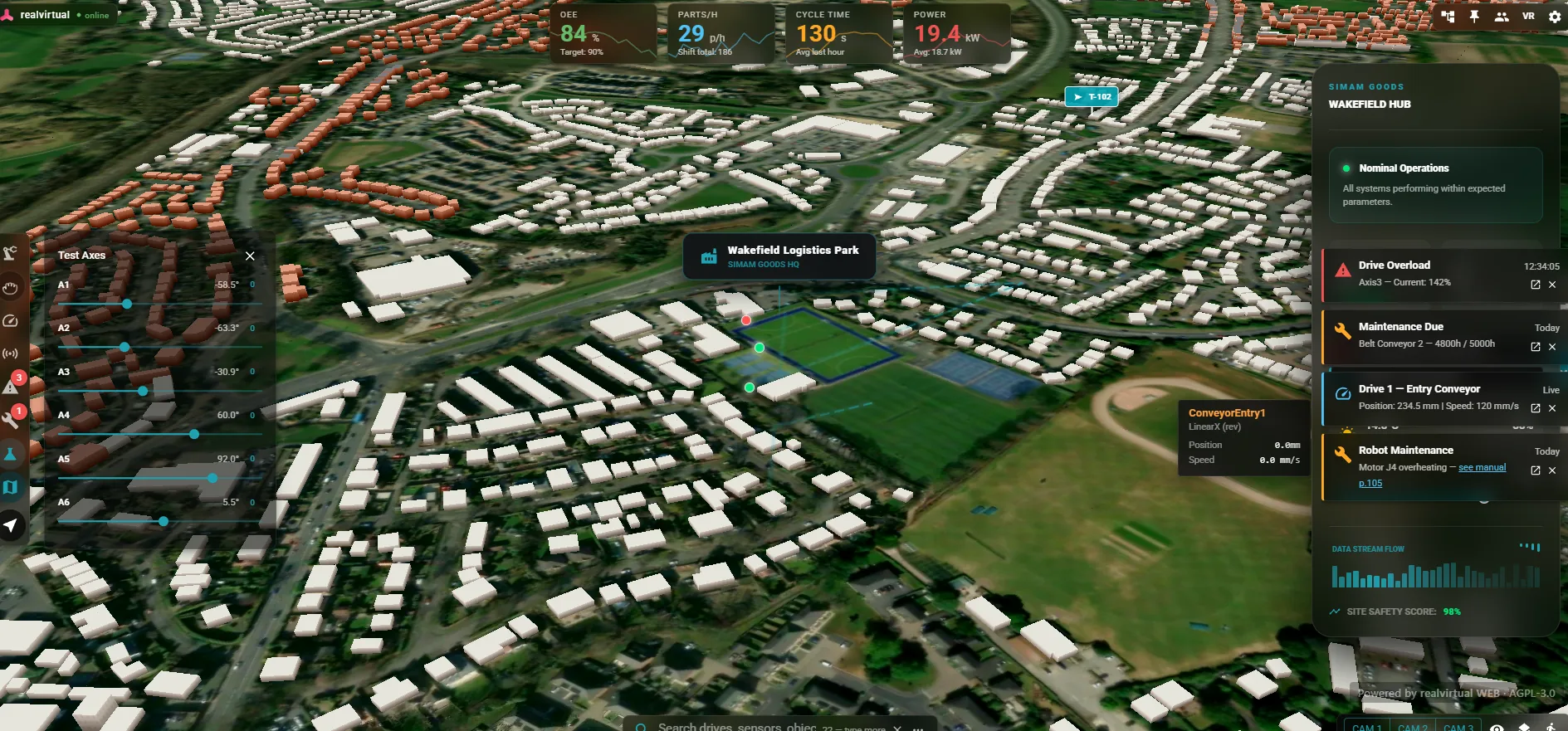
Rockwell Automation put NVIDIA Omniverse, RTX rendering and OpenUSD into Emulate3D, announced at Automation Fair 2026. The stated aim is to move virtual commissioning from testing a machine to testing a factory: connect simulated equipment to real or emulated control logic and find the problems before anything is installed. GE Appliances is the named customer, and its senior manager for advanced manufacturing simulation is quoted on the value of testing ideas virtually as systems get more complex.
NVIDIA published around twenty worked examples of AI agents building simulations, dated 19 November. Not a demo reel: named developers, named libraries, specific outcomes. A pick-and-place robot moving a can. A study room modelled in Blender from two reference photographs, then given a voice interface in VR. A gas-turbine what-if app streamed to a browser. A warehouse with eighty conveyors, forty arms and eight hundred boxes holding thirty frames a second in a two-minute test. A facility-scale platform from Falkor, a KONGSBERG company, turning CAD and engineering data into digital twins on server GPUs in Microsoft Azure.
Autodesk and Esri brought captured reality into established tools, with native splat display and 4D sequence playback in 3ds Max, and a first pass at splat layers inside immersive GIS scenes. Both matter for a different reason, covered elsewhere on this site.
Read together, the message is not that simulation got cheaper. It is that building a simulation got cheaper, which is not the same claim and has different consequences for whoever signs it off.
The agents got fast at the part that was never the bottleneck.
Anybody who has delivered an industrial twin knows where the time goes, and it is not modelling. It goes on finding out what is actually there, reconciling three drawings that disagree, getting a controls engineer to confirm what a signal means, and then proving that what you built responds the way the real line responds.
Agents are now genuinely good at the first part. Give one a CAD assembly and it will produce a scene with joints, colliders and sensible physical properties. Give it reference photographs and it will model a room. That is real and it compresses weeks of work.
Assembly was never what made a digital twin expensive. Agreement with reality was.
None of it touches the second part. An agent can estimate that a gripper pad has a certain friction coefficient. It cannot tell you whether that estimate matches the pad fitted to the machine in your plant, because that information does not exist anywhere it can reach. Somebody has to go and measure, or accept the estimate and say so in writing.
NVIDIA’s own post is unusually honest about this.
It would be easy to read a vendor post as pure promotion. This one is worth reading closely, because the caveats are more useful than the achievements, and they are stated rather than buried.
On the voice-controlled VR build, the developer reports that the coding agent worked for about eight hours and he assembled the application over a weekend. Then this: automated tests missed problems he could feel, including objects shaking when grabbed. He reported the symptoms, guided the agent through the fix and verified the interaction himself. The conclusion he draws is that you give an agent renders and logs, and then you still go and feel the thing.
On the CAD-to-simulation conversion of a two-armed industrial robot, both arms completed four pick-and-place cycles with simulated finger contact and friction. The post adds, in plain language, that this demonstrated behaviour under the simulated conditions and that the estimated physical properties were not calibrated against the real robot.
On a cable-routing task, the next steps are listed as testing a friction-held grasp and using the information a physical robot could obtain from its own cameras and sensors, before moving to physical-robot experiments.
And on a humanoid obstacle course, the robot cleared a hurdle in 64 of 100 trials, which is a real number of a kind that marketing copy does not usually carry.
Every one of those is the same admission from a different angle. The simulation is a hypothesis about the physical world. Agents make hypotheses quickly. Nothing in the toolchain makes them true.
Why this is a procurement question, not an engineering curiosity.
If building a twin drops from eight weeks to eight days, the obvious move is to buy more twins. That is usually the wrong move, and the reason is arithmetic rather than caution.
A twin that nobody has checked against the plant is not a cheaper twin. It is a different product: a well-informed drawing. It is genuinely useful for layout, access, clearance, training and explaining a scheme to people who cannot read a drawing. It is not usable for the decisions that pay for the exercise, which are the ones where somebody changes the physical factory and spends money on the strength of what the model said.
So the cost that matters moves. It used to sit in construction. It now sits in validation, and validation does not compress the way modelling just did, because it is bounded by access to the real asset: a shutdown window, an instrumented run, a controls engineer with a free afternoon.
Notice also what Rockwell’s announcement does not contain. There are no commissioning savings quoted, no accuracy figures and no statement of how the named customer actually uses the software. That is not a criticism of the product. It is a reminder that the person who has to justify the spend will not find the number in the press release, and should ask for it directly.
What we think a buyer should ask.
Five questions. They are deliberately boring, and a supplier who answers them well is worth more than one with a better render.
What was this checked against, and when? A drawing, a survey, an instrumented run, or nothing. All four are legitimate answers. Only one of them is a measurement, and the date matters because a plant changes.
Which numbers in here are measured, which are estimated, and which are illustrative? A twin that cannot answer this per figure is not ready to support a decision. Our own capture work labels every figure on the screen it appears on for exactly this reason.
What is this twin not allowed to decide? Every honest model has a boundary. Ours is stated plainly: a capture is a record, not a survey, and where an area, a boundary or a quantity has to be settled, the surveyed figure rules.
Who signs it off, and what do they look at? If the answer is that the tests pass, read the NVIDIA post again. Automated tests missed objects shaking when grabbed.
What happens when the real thing changes? A twin validated once is accurate once. The second capture is what turns a picture into a record, and it is the part most proposals leave out.
Where we sit on it.
We build captured-reality twins and we use AI assistance in doing it, so this is not a warning from the sidelines. Two things follow from the work rather than from the news.
The first is that honesty about accuracy is a feature, not a disclaimer. Every figure in our builds is marked measured, sample, estimated or illustrative on the screen it appears on, and our published measurement margin is stated with the reason for it rather than asserted. That is not modesty. It is the thing that lets somebody act on the parts that are solid.
The second is that the validation step is where a specialist is actually worth paying. Anyone can now generate a plausible industrial scene. Rather fewer people can tell you which parts of it you are allowed to believe, and that judgement is not something an agent currently offers, because the agent has no access to the plant.
If you are weighing up a simulation or twin programme and the proposals in front of you are competing on build speed, that is the signal to change the question.
What this means for a buyer.
Start with the business decision, audience, and evidence the project must produce. Simam Digital can turn that into a focused discovery, prototype, MVP, or production roadmap across AI applications, SaaS platforms, digital twins, real-time 3D, XR, and interactive systems.