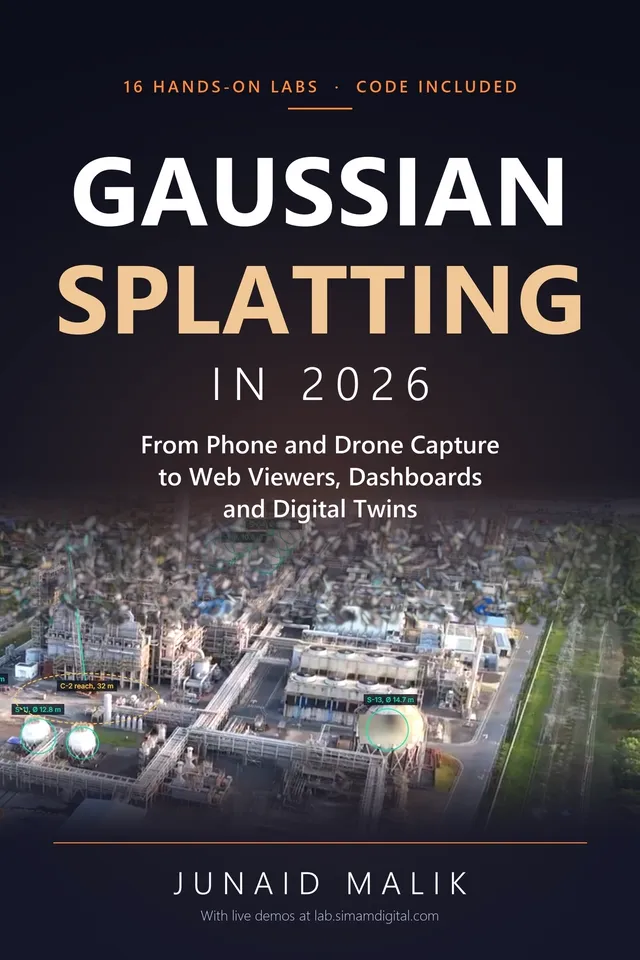
Gaussian Splatting in 2026
From phone and drone capture to web viewers, dashboards and digital twins.
By Junaid Malik. First edition, November 2026.
People kept asking how we make our 3D scenes. This is the answer: a hands-on guide that takes you from a phone or drone clip to an interactive 3D scene on the web, with the code.
There is a launch price on the PDF and EPUB until 3 December. This link applies it for you, with nothing to type in.
Outside the UK? Kindle on Amazon.com.
What is in it
Capture
Phones, drones, 360 cameras and a Meta Quest 3 headset, and how to film so the scene reconstructs the first time rather than the fourth.
Processing
Picking sharp frames, checking the camera solve with COLMAP, training in LichtFeld Studio, Postshot and others, masking people out, and whether to run it on your own GPU or rent one.
Quality you can show a client
How to measure a splat honestly, with scores that mean something to somebody who is paying for it.
The web and VR
Getting a scene small enough to stream, viewers built with Spark and three.js, React apps, and the same scene in a headset.
Making it do something
Click to pick, measurements, hotspots, guided tours, asking questions of the scene, and live data laid over the top as a dashboard.
Seven real projects, rebuilt
Construction progress, a property viewer, a heritage story, a 360 walk, a room in a headset, a moment in 4D, and reflective cars.
The business side
What a job costs, how to package it, and how to deliver splat work to a client without losing money on the third revision.
The short version
- 41 chapters in seven partswith answers at the back
- 16 hands-on labsin two tracks: the pipeline first, then the experiences
- 324 pagesfirst edition, November 2026
- One ordinary gaming GPUwritten and tested on an RTX 4070 with 12 GB
- Real numbers from our own labincluding the runs that failed
- Free updates to this editiona 2027 edition is planned and is separate
If you are buying it for a team
The labs are built to be worked through in order, so a team can take the pipeline track first and the experiences track second and end up with the same scenes on the same machines. It runs on one ordinary gaming GPU, which means nobody has to buy hardware to follow along.
Anything we have not tested ourselves is labelled as such. The numbers come from our own lab, including the runs that did not work, because a book that only reports the successes is not much use on a Tuesday afternoon when yours has not worked either.
This is the work behind Simam Spatial AI and its two offerings, Spatial Capture and Spatial Intelligence, written down so you can do it yourself. If you would rather we did it, tell us what you need.
Getting the code, and two offers
Every script and page from the labs is in the code download, under the MIT licence. If you buy the PDF and EPUB it is included. If you buy on Kindle, email your Amazon receipt to junaid.malik@simamdigital.com and we will send it to you.
Readers get a discount on our templates and kits. Email the same address with your receipt and which template you want.
Universities and colleges teaching at Level 5, Level 6 and above can email junaid.malik@simamdigital.com about a discount for a class.