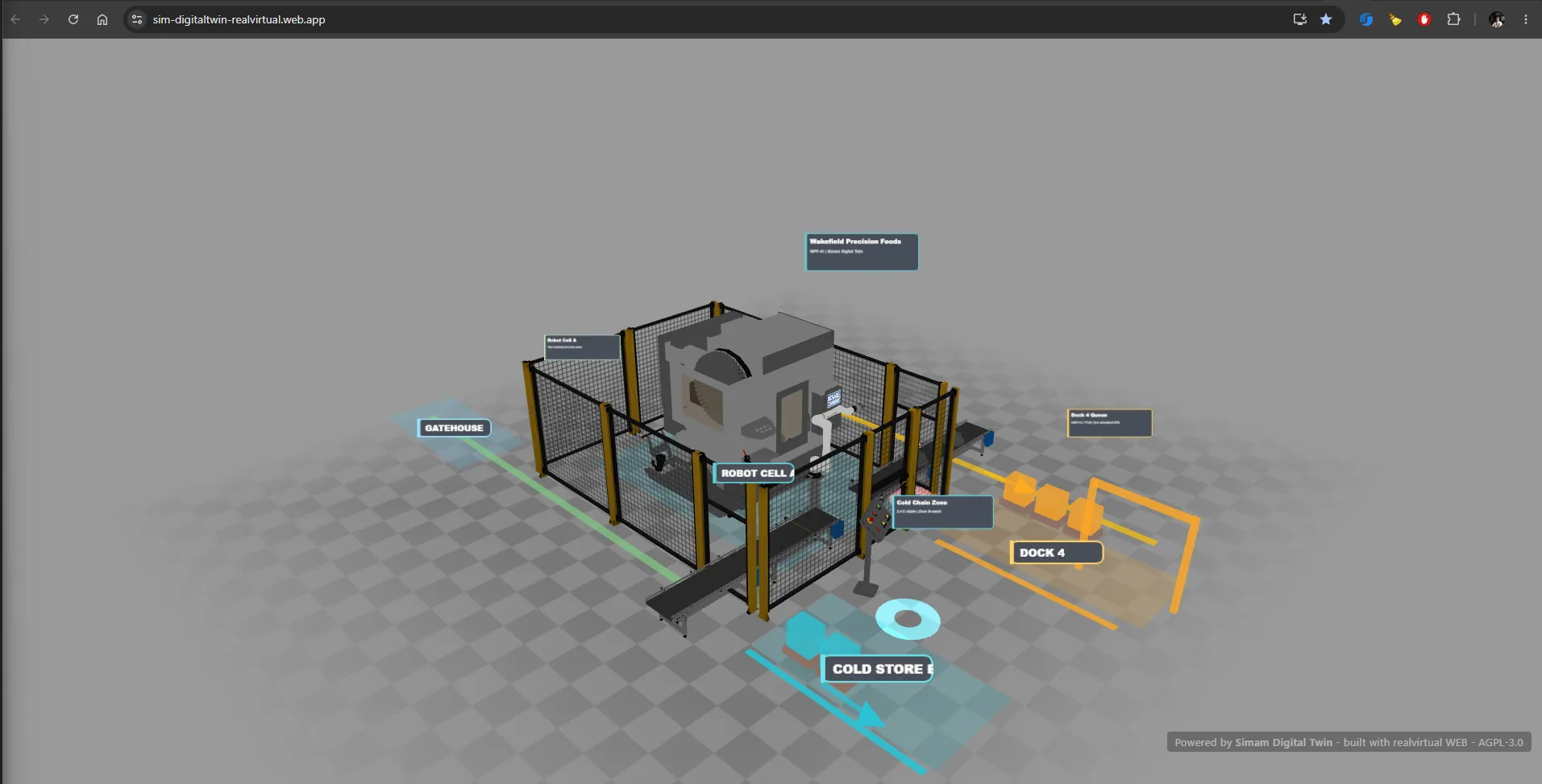
The first generation answered a question nobody was really paying for.
Gaussian splatting arrived as a rendering breakthrough and was received, commercially, as a photography breakthrough. Capture a place, get a photoreal scene you can fly through in a browser. It is genuinely remarkable and it sold a great many demonstrations.
It also ran into a ceiling quite quickly, and the ceiling is structural rather than a matter of quality. A splat is millions of small oriented coloured blobs fitted to photographs. It has no notion of objects, no materials, no physics, no semantics. It does not know which blobs are a wall and which are a forklift, because nothing in the representation has any concept of either.
A photoreal reconstruction can show you a factory. It cannot tell you anything about the factory.
That is fine when the deliverable is a walkthrough. It is fatal the moment somebody asks the obvious follow-up question, which in an industrial setting is always some version of: and then what can we compute with it? Can we simulate a sensor against it? Can we plan a route through it? Can we ask what happens if this moves? The answer, for a plain splat, is no — and that answer is why so many capture pilots ended as beautiful artefacts nobody opened twice.
What the second generation is actually attacking.
The interesting thing about 2026 is not one breakthrough. It is that several independent groups are attacking the same gap from different sides, which usually means a field has found its real problem.
Materials, so a scene can be sensed rather than seen. Material-informed Gaussian splatting by Huynh, Silva, Caesar and Son extracts semantic material masks with vision models, converts the Gaussian representation to mesh surfaces, and assigns physics-based material properties so the result can drive accurate sensor simulation. The authors validate a camera-only pipeline against LiDAR ground truth on vehicle test data, which is the part a buyer should notice: the goal is removing the LiDAR requirement, not decorating the render.
Physics, so a scene can be acted on. GaussTwin by Cai, Jansonnie, de Farias, Arenz and Peters couples position-based dynamics and Cosserat rod formulations for physically grounded simulation with Gaussian splatting for rendering and visual correction, anchoring the Gaussians to physical primitives. They test on a Franka robot and report better tracking accuracy than rigid-only baselines, with push-based planning as a downstream application.
Semantics, so a sparse industrial capture holds together at all. Semantic-guided 3D Gaussian splatting by Li, Gao, Gu and Liu targets the specific misery of factory reconstruction, where you cannot walk where you like and occlusion is constant. It pairs Gaussians with end-to-end pose estimation instead of requiring pre-calibrated cameras, uses segmentation to decompose the scene hierarchically so optimisation stays stable, and extracts lightweight meshes from the result. The authors position it for automated inspection and remote equipment monitoring.
Articulation, so the things in a scene can move the way they really move. ArtiTwinSplat reconstructs interactable, articulated digital twins from RGB-D video — objects with hinges and drawers and joints, reconstructed as things that open rather than as shapes that look like they might.
  What each line of work adds to a splat

  plain 3DGS
    geometry-ish + appearance
    knows: nothing

  + material semantics
    knows: what surfaces are made of
    unlocks: sensor simulation

  + physics coupling
    knows: how things respond to force
    unlocks: manipulation, planning

  + scene decomposition
    knows: which blobs are one object
    unlocks: sparse capture, inspection

  + articulation
    knows: what moves against what
    unlocks: interaction, training data

  The direction of travel is consistent:
  from a recording of appearance toward
  a model you can compute against.
Why this matters more to industry than to media.
The media applications of splatting — virtual tours, heritage, product visuals — are real and are already being served. They are also satisfied by the first generation, because looking right is the entire requirement.
Industrial applications were never satisfied by that, and this is where the second generation lands.
Simulation needs a world, not a picture. If you are testing a sensor, a route, a robot or a process, you need a scene with material and physical properties. Building those scenes by hand is the reason simulation programmes are expensive. Reconstructing them from photographs, with properties attached, changes the cost structure of the whole activity.
Robotics needs scenes it can fail in safely. The value of a twin for a robot is that mistakes are free. That only works if the twin behaves plausibly, which means physics, which is exactly what has been missing.
Inspection needs objects, not blobs. “Has this changed since last quarter” is a question about a thing. A representation with no notion of things cannot answer it, however photoreal.
The first generation reconstructed how the world looks. The second is trying to reconstruct how the world behaves — and only the second one is worth connecting to an operational system.
The constraint everyone is attacking: how few photographs will do.
Read these papers together and a shared obsession shows up that is not about quality at all. It is about how little input you can get away with.
Sparse-view reconstruction. Camera-only instead of LiDAR. Pose estimation instead of calibration. End-to-end instead of a rig. Every one of those is the same commercial problem wearing a different hat: capture effort is what kills these programmes, not rendering quality.
That is worth internalising if you are planning anything in this area, because it tells you where to spend attention. The question that decides whether a spatial programme survives is almost never “is the reconstruction good enough”. It is “can somebody who already works here produce an acceptable capture during a normal shift, without a shutdown, and do it again in six months”. Every research direction above is, in effect, an attempt to make the answer yes.
We have written separately about using CAD you already own as the geometric backbone, which attacks the same constraint from the other end.
What is real now, and what is not.
A blunt maturity table, because the gap between a paper and a purchase order is where money is lost in this field.
| Capability | State in late 2026 | What to do about it |
|---|---|---|
| Photoreal capture, browser delivery | Production. Ordinary work. | Use it. This is a solved, procurable thing. |
| Mesh extraction from a splat | Working, quality varies by scene | Viable where the downstream tool needs geometry rather than accuracy. |
| Semantic decomposition of a captured scene | Research, moving quickly | Watch. Do not write it into a 2026 delivery plan. |
| Material properties for sensor simulation | Research, promising validation | Relevant if you already run sensor simulation. Talk to your simulation team, not a capture vendor. |
| Physics-coupled reconstruction for robotics | Research, single-lab results | Interesting direction, nothing to buy. |
| Articulated interactable twins | Early research | Note it and move on. |
The honest summary is that one row of that table is a product and the rest are directions. Anybody selling you the bottom four rows as a service in 2026 is selling you a research project with a margin on it.
What to actually do with this information.
Three things, none of which involve procurement.
Fix the capture habit, not the capture technology. Everything above becomes available to you only if you have imagery of your assets. Establishing a cheap, repeatable capture routine now — someone walking a site with a camera on a schedule — is the single highest-value preparation, and it is valuable even if none of this research ships.
Keep the raw material. Reconstruction methods are improving faster than anything else in this field. The photographs you take this year can be reprocessed with next year’s method; a finished reconstruction cannot. Archive the source imagery with its metadata, not only the output.
Write down the computation you would want. “We want a digital twin” is not a requirement. “We want to test a sensor placement without a shutdown” is. When one of these research lines does mature, the organisations that benefit will be the ones who already knew what they wanted to compute.
If it is worth an hour of structured thinking rather than a project, our Idea Validation Sprint at £495 is built for exactly that kind of question, and prototype work starts from £3,250 if something concrete falls out of it.
Where we actually stand on this.
Setting out the line between what we operate and what we are reading, because this is an article largely about research.
What we run in production: static Gaussian splat capture, cleanup, editing and browser delivery, through our own splat editor and Simam 3D Studio, with published scenes in our Gaussian gallery and delivery against real sites, including a capture that became the navigational source of truth where drawings had fallen behind.
What we build around operational data: browser-based twins that connect 3D to live systems — our Connected Highways twin and the work behind Simam BIM. That is the half of this problem we deal with daily: making a 3D scene answer a question rather than merely display.
What we have not done: shipped material-informed, physics-coupled or articulated splat reconstruction. None of it is in a client pipeline, ours or anyone else’s that we are aware of. The papers above are the evidence for this article, and we have linked all four so you can judge them yourself rather than take our summary on trust.
We are writing this because the direction changes what is worth preparing for, not because there is something to sell against it. If that distinction seems pedantic, it is the one that separates a useful technology radar from a sales document.
What this means for a buyer.
Start with the business decision, audience, and evidence the project must produce. Simam Digital can turn that into a focused discovery, prototype, MVP, or production roadmap across AI applications, SaaS platforms, digital twins, real-time 3D, XR, and interactive systems.
Sources and further reading
- Material-informed Gaussian Splatting for 3D World Reconstruction in a Digital Twin
- GaussTwin: Unified Simulation and Correction with Gaussian Splatting for Robotic Digital Twins
- Semantic-guided 3D Gaussian splatting for sparse-view reconstruction in industrial digital twins
- ArtiTwinSplat: Interactable Digital Twin Reconstruction via Gaussian Splatting from RGB-D videos
- 3D Gaussian Splatting for Real-Time Radiance Field Rendering (Kerbl et al.)