The difference in one line each
Strip away the marketing and each term has a precise meaning that is easy to test.
- 3D visualisation: a model you can look at and move around. It looks the same every time you open it. Its job is communication.
- Simulation: a model that runs a scenario. You change an input, it computes an outcome. Its job is prediction.
- Digital twin: a model connected to the real thing by live data. When the asset changes, the twin changes. Its job is operational awareness.
The test that separates them takes one question: what happens if I open this tomorrow and nothing has changed in the real world? A visualisation is identical. A simulation is identical unless you change an input. A twin has moved, because the world moved.
Side by side
| 3D visualisation | Simulation | Digital twin | |
|---|---|---|---|
| Answers | What does it look like? | What would happen if? | What is happening now? |
| Live data | None | Not required | Essential — it is the definition |
| Updates | When someone rebuilds it | When you run it again | Continuously |
| Built by | 3D artists | Engineers and modellers | Software and data engineers |
| Main cost | Asset creation | Getting the model right | Integration and keeping it alive |
| Ongoing cost | Near zero | Low | Real and permanent |
| Typical buyer | Marketing, sales, planning | Engineering, risk | Operations |
| Fails when | Mistaken for a decision tool | Inputs are wrong | The data feed stops |
3D visualisation
This is the most common of the three and the most useful per pound spent. A rendered building, a walkthrough of a plant, a Gaussian splat of a real site, a product you can rotate. It exists to get an idea into someone's head faster than a drawing can.
It is the right choice when the problem is explaining: selling a scheme before it is built, briefing a crew on a layout, showing a client a space, winning a planning argument. Nobody needs live data to understand what a room will feel like.
Where it goes wrong is when it gets bought as an operations tool. A beautiful model of a facility does not tell you that pump four is running hot. It was never going to.
Simulation
A simulation encodes rules about how something behaves and runs them forward. Crowd flow through a stadium concourse, traffic on a junction, heat through a building, throughput on a production line.
The output is a forecast, and the forecast is only ever as good as the model. Simulation work is mathematically demanding and the cost sits in getting the behaviour right, not in how it looks. A simulation with a plain 2D output and correct physics is worth far more than a beautiful one with invented assumptions.
Use it when the decision is irreversible and expensive: before you pour concrete, before you commit to a layout, before you change a process that is hard to change back.
Digital twin
A digital twin is a live software model of a real asset, fed by real data from that asset. Sensors, telemetry, a maintenance system, a booking system, a BMS — the sources vary; the live connection does not.
What makes it valuable is not the model. It is having asset state, context and history in one place, so that the person on shift can see a problem and act on it without opening five systems and phoning two people.
What makes it expensive is also not the model. It is the integration — and the fact that a twin is never finished. Every feed has to keep working. Every source system that changes breaks something. A twin is a product you operate, not a project you complete, and organisations that budget for it as a one-off delivery are the ones that end up with an expensive screen nobody trusts.
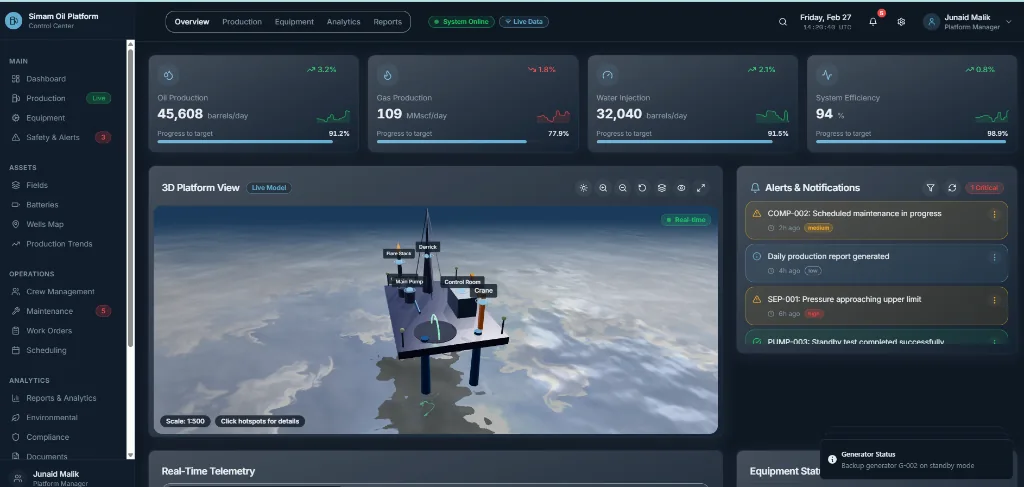
Note that a twin does not have to be 3D at all. A well-built dashboard fed by live asset data is a digital twin. The 3D view is a presentation choice, and often not the most useful one.
Most things sold as digital twins are not
This is the part worth being blunt about, because it is where money gets wasted.
A large share of what is marketed as a digital twin is a 3D visualisation with a live data badge: a detailed model, some sensor values pinned to hotspots, and no meaningful connection between the two. It demos extremely well. It changes no decisions.
Three questions will expose it in a sales meeting:
- Which live systems does it read from, and how often? A real answer names systems and intervals. A vague one means there is no feed.
- What happens on screen when a value goes out of range? If nothing does, it is a viewer.
- Who looks at this during a shift, and what do they do differently because of it? If nobody can name that person, the twin has no job.
None of this makes 3D visualisation a bad purchase. It makes it a bad purchase at digital twin prices.
Which one do you need
Work backwards from the decision, not from the technology.
- If you need someone to understand something: 3D visualisation.
- If you need to choose between options before committing: simulation.
- If you need someone to act during a shift: digital twin — and quite possibly a dashboard rather than a 3D one.
- If you are not sure, you almost certainly want the cheapest of the three that answers the question. That is nearly always the visualisation or a plain operational dashboard.
What each costs
Rough starting bands, using our own published pricing:
- 3D visualisation or splat capture: from £2,800 for a focused piece.
- Working prototype of a twin or dashboard against sample data: from £2,800, or £495 for the validation sprint that decides whether it is worth building at all.
- Branded MVP with a live feed from one real source: from £9,000.
- Production digital twin with multiple integrations, permissions and monitoring: from £28,000, plus ongoing running cost you should plan for from day one.
Simulation cost varies too much with the domain to band honestly — it depends entirely on how well understood the underlying behaviour already is.
If you want the longer version of the twin argument, read our full digital twin guide. If you want to know which of the three your problem actually needs, that is a short conversation and we are happy to have it before anyone quotes anything.
Common questions
What makes something a digital twin rather than a 3D model?
A live data connection. If the on-screen state changes when the real thing changes, it is a twin. If it looks identical every time you open it, it is a 3D visualisation, however detailed it is.
Can a digital twin exist without 3D?
Yes, and many of the most useful ones do. A digital twin is a live data model of a real asset. A well-built dashboard of sensor readings qualifies. The 3D view is a presentation layer, not the definition.
Is a simulation a digital twin?
No. A simulation models what would happen under conditions you specify. A twin reflects what is happening now. The two combine well - a mature twin can feed real current state into a simulation to forecast - but they answer different questions.
Which should a business start with?
Almost always the cheapest one that answers the actual question. Most organisations that ask us for a digital twin need either a 3D visualisation for communication or a plain operational dashboard for decisions. Start there and add the live connection when you know what you would do with it.