Three healthcare prototypes, open for anyone to try.
A primary care practice run from one screen, acute
ward coordination with an AI layer that drafts and never commits, and an
operations twin that goes from an estate map down to a floor plan. All
three are live and you can open them now.
Nobody commissioned any of this. We
built them at our own expense, every record inside them is invented, and
none of them is clinical software. What they are is the clearest way we
have of showing how we build something people have to use while they are
busy.
MediBase
A whole practice on one screen
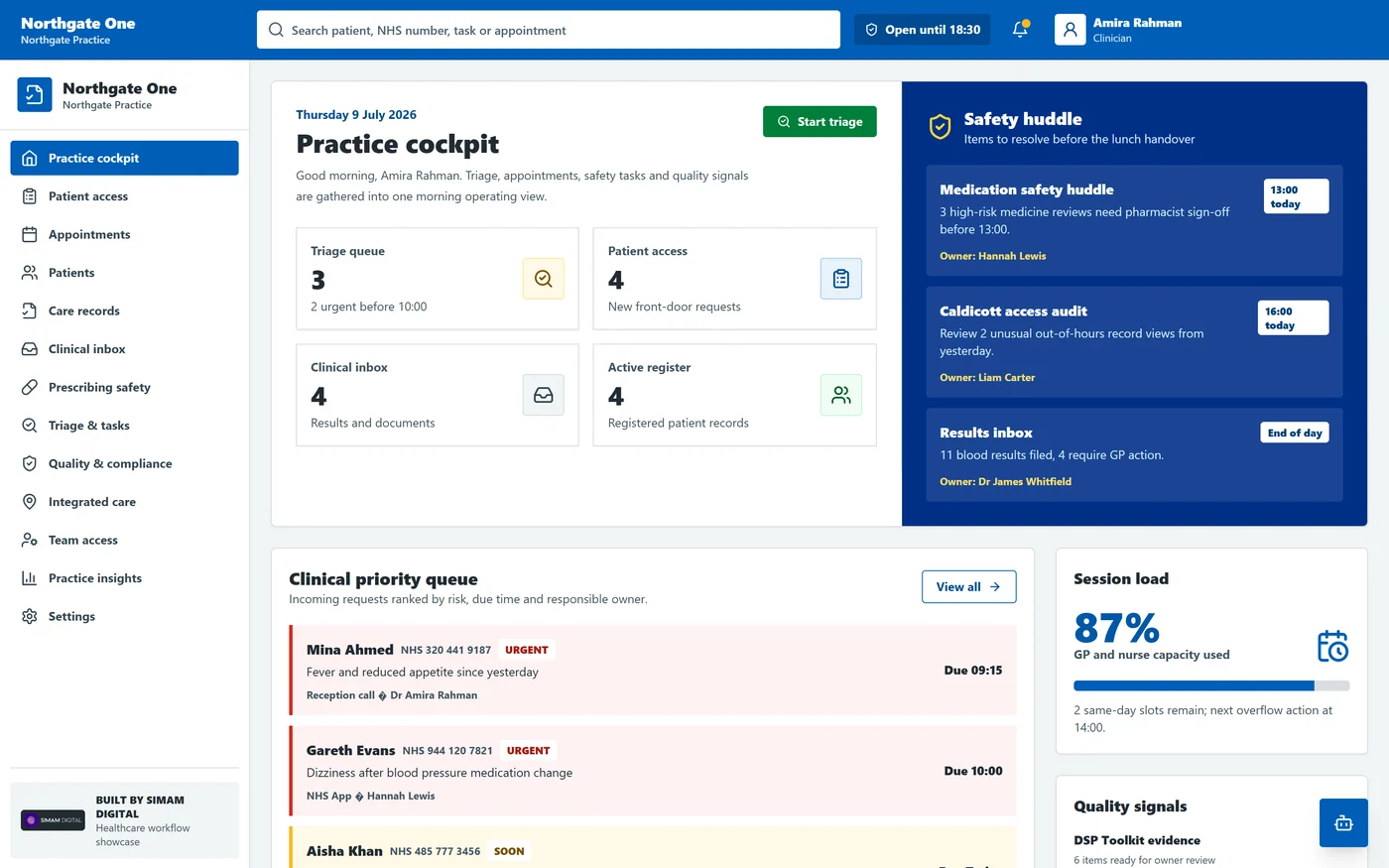
Access requests, triage, the clinical inbox and the active register in one morning view, with a priority queue ordered by risk and due time rather than by arrival. The safety huddle panel carries the items somebody has to resolve before the next handover, each with a named owner and a time.
Work ordered by risk and due time, with an owner on every item
Quality and compliance evidence gathered as a by-product
SympliCare
An AI layer that drafts and never commits
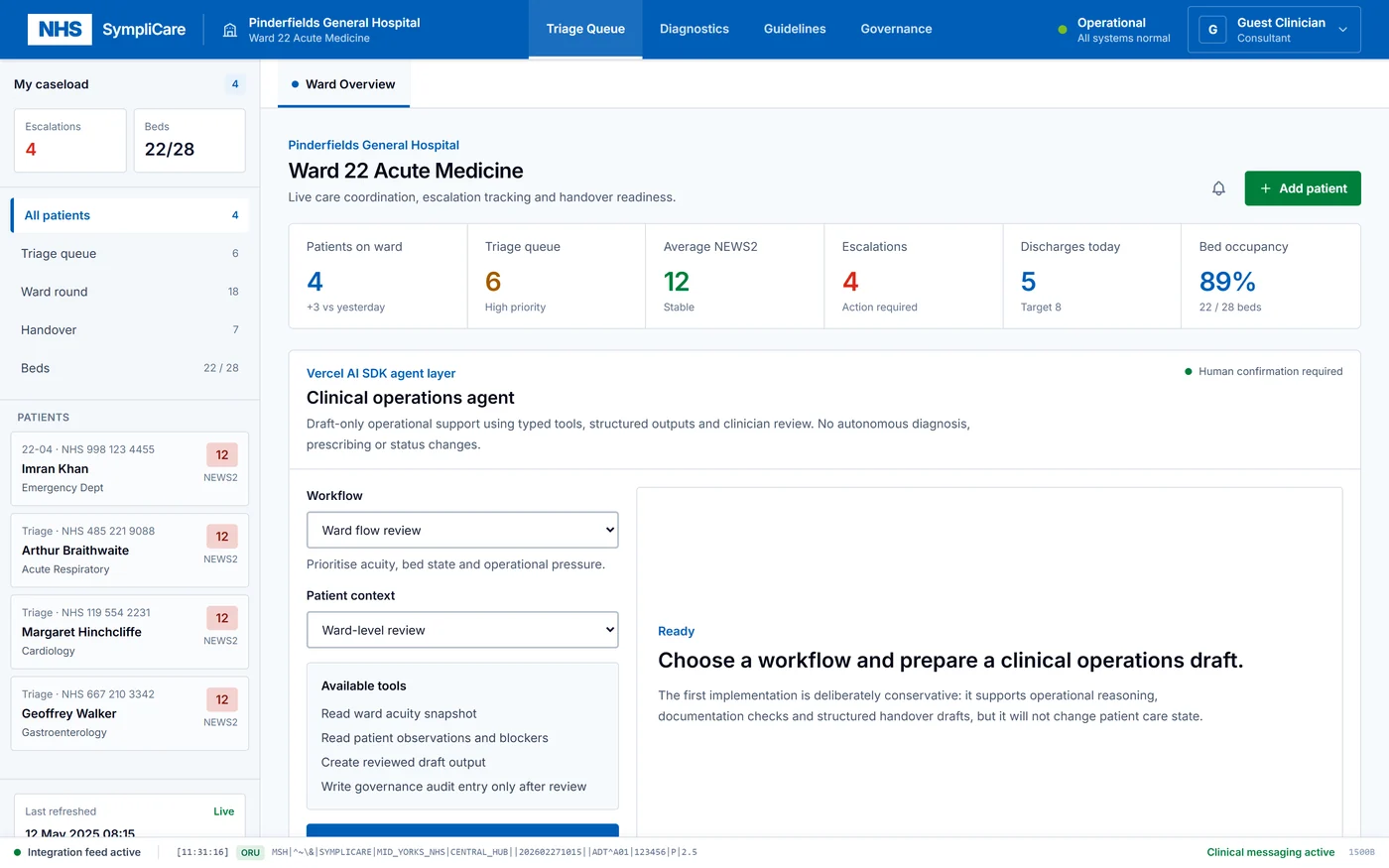
Ward coordination, escalation tracking and handover readiness, with an agent layer beside it that is deliberately boxed in. It reads the ward snapshot and observations, prepares a draft, and writes an audit entry. It does not change anybody’s care state, and the tools it may call are listed on screen.
The model proposes, a clinician commits, and the split is visible
Every available tool named in the interface, not buried in config
A governance entry written after review, not instead of it
Vantage Health Operations Twin
An estate, from the map down to the floor
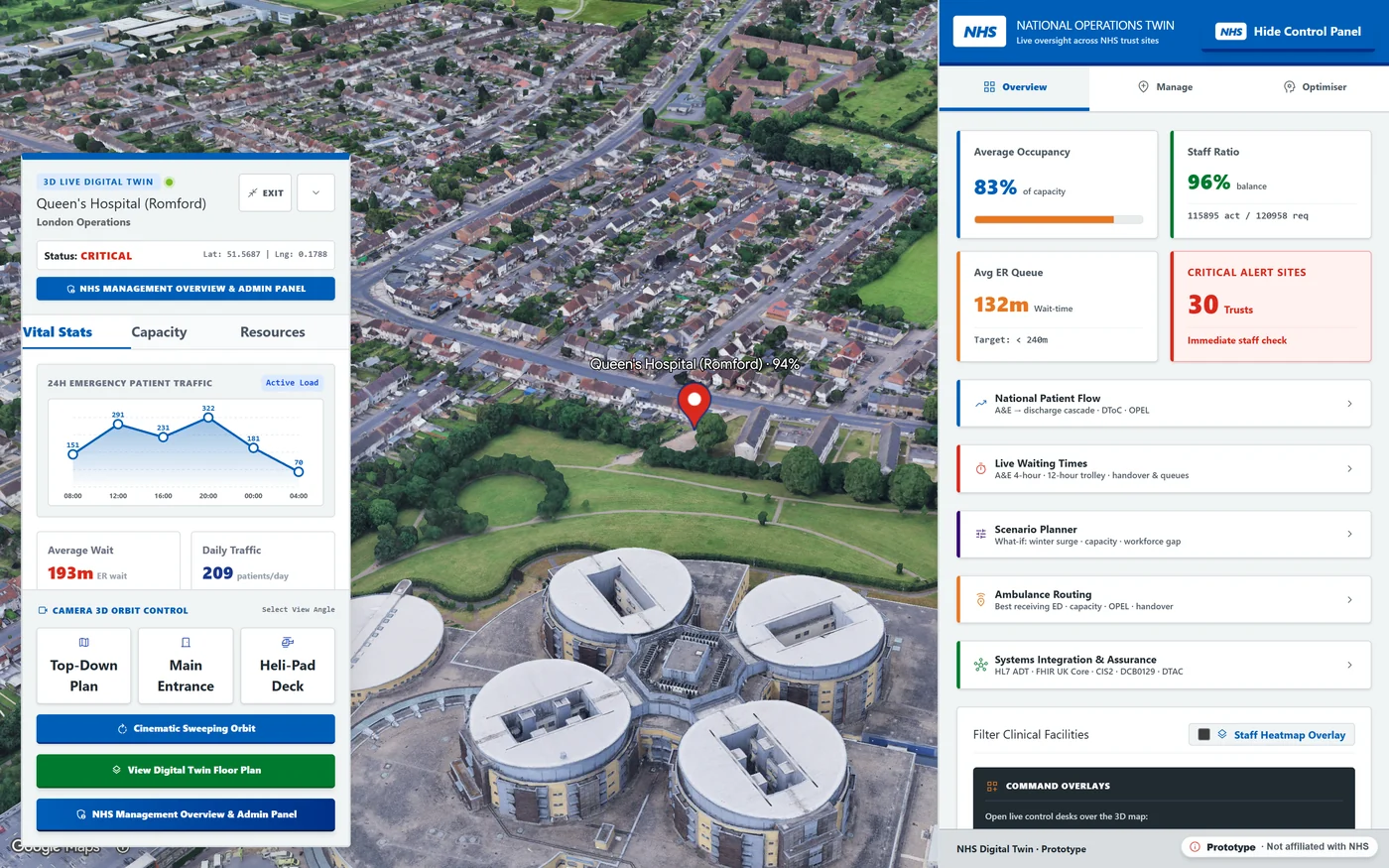
Operations across a whole estate on one surface: a national view of sites, then a single site in 3D, then the floor plan inside it. Capacity, waiting times, transfer backlog and a scenario planner that re-runs the same model as the live view, so a rehearsal can never quietly disagree with the operational picture beside it.
Three zoom levels of the same data, not three separate products
A scenario planner that shares the live model
Built to be read at a glance from across a room
Read this before you draw conclusions
Nobody commissioned these.
We built all three at our own expense to test patterns we kept running into. They are not case studies and there is no client behind them.
Every record inside them is invented.
Names, numbers, occupancy figures, waiting times and outcomes are all made up for the demonstration. Nothing in them came from a real organisation and no real data has ever been in them.
They are not clinical software.
Nothing in them diagnoses, prescribes, or changes a care record. They are operational tools: queues, beds, handover, capacity and the evidence trail around those.
They are not affiliated with any health service.
They are independent concepts. The styling inside them is a visual study of what this kind of tool looks like in use, not a claim of any relationship with anybody.
Why we built them
The interesting problem was never the model
Every one of these started from the same observation. The hard part of software in a care setting is not making something clever. It is that the people using it are interrupted, tired and accountable, so the interface has to survive being read in four seconds by somebody who was doing something else a moment ago.
Draft-only is a design, not a limitation
The agent layer in SympliCare can prepare a handover draft and cannot change a patient’s status. That boundary is the whole design. Systems that blur it are the ones that get switched off after the first surprise, and we would rather build the version that survives its second month.
An audit trail has to be written by the thing that acted
Governance bolted on afterwards records what somebody remembered. In these, the record is written where the action happens, which is the same principle as our agent harness and the reason that project exists.
If this is the kind of thing you need
We build operational software for people who are busy.
We have no healthcare clients, and we would rather
say so than let three convincing prototypes imply otherwise. What we do
have is the engineering behind them, and most of it is not specific to
care at all: queues, capacity, handover, an approval step and a record
of what happened are the same problems in logistics, construction and
field operations, which is where our delivered work actually is.
If you have an operational problem shaped like one
of these, tell
us what it is and we will tell you plainly whether we are the right
people for it. You can also read how we
work, see the agent
harness that the governance ideas above come from, or look at
Simam Local LM, which applies the
same ask-before-acting rule to a model running on your own machine.
Start a project
We will come back with an approach and a cost.
Every project is bespoke and quoted after we understand it. You deal with the engineer who would do the work, and we reply within one working day.