What the platforms are genuinely good at.
This is not an article about replacing anything. Modern construction management software is good, and the common criticisms of it are mostly complaints about implementation.
Tasks, programmes and dependencies. Drawing registers and versions. RFIs with an audit trail. Snagging with responsibility attached. Daily reports, timesheets, certification. All of it genuinely better than the paper it replaced.
Every one of those is a record of intent and process: what was meant to happen, who was asked, what was signed. That is most of what a project needs.
The thing almost none of them holds.
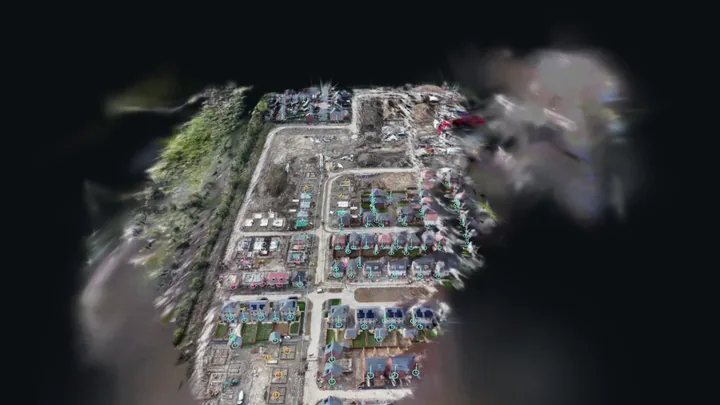
A dated visual record of the whole site, that anybody can open without a licence.
Most platforms have photo uploads. In practice what that produces is thousands of images taken by different people for different reasons, framed tightly on whatever prompted them, with no coverage of anything nobody was worried about yet.
You cannot search a folder of photographs for the thing nobody photographed.
The questions that arrive later are almost always about exactly that: the drainage run before it was covered, the condition of a neighbour’s wall before the works, what was standing in the corner the week of the claim. Nobody takes that photograph, because on the day it was not interesting.
Four places the gap costs money.
Payment and variation claims. These are arguments about what existed on a date. A dated capture of the whole site is evidence in a way a phone gallery is not, and it is evidence that existed before anybody knew there would be a dispute.
Dilapidation and neighbour disputes. The condition of what you did not build, before you started. Cheap to capture on day one and impossible to reconstruct afterwards.
Work that gets covered. Services, substructure, anything behind a wall. There is one window to record it and it does not reopen.
Progress for somebody who is not on site. A lender, a client, a board. A percentage in a report is somebody’s judgement; a link they can open is not. Our sample build of a tower going up shows the shape of it — five stages read off one flight, with a progress share that is clearly labelled as sample data.
What it does and does not replace.
| Question | Answered by the platform | Answered by a capture |
|---|---|---|
| Who was responsible for this task? | Yes | No |
| Which drawing revision was current? | Yes | No |
| Is this snag closed out? | Yes | No |
| What did the north elevation look like in March? | Rarely | Yes |
| What was under the slab before the pour? | Only if somebody photographed it | Yes, if the capture caught that date |
| Can a lender see progress without a visit? | A report | A link they open themselves |
| What is the exact quantity of this element? | From the model | No. See below. |
The two belong side by side. The platform holds the paperwork and the responsibility; the capture holds what the place actually looked like.
The measurement warning, before anybody builds a claim on it.
This needs saying clearly because the temptation is obvious.
A reconstruction has no inherent scale. Set from the storeys of a building, our own figures land roughly 10 to 20 per cent out. Set from the flying height of a drone with nothing in frame to count, nearer 30. Set from a length measured on site, considerably tighter. For a walk round with a phone or a 360 camera we have not measured the error at all.
So a capture is for seeing and comparing. It is not a quantity surveyor, it does not settle a boundary, and where a figure matters legally or commercially the surveyed number rules. Anybody offering you survey accuracy from ordinary video is either confused or hoping you are.
How to start without a programme.
The mistake is treating this as a system to procure. It is a habit to establish, and it is cheap enough to start on one site.
Capture before you need it. The valuable record is always of a date nobody thought would matter. Day one, before anything moves, is the highest-value capture of the job and the one most often skipped.
Pick an interval and keep it. Monthly suits most sites. A quarter suits slow ones. The interval matters less than never missing one.
Keep the source material, not only the output. Reconstruction methods improve every year. Footage captured now can be rebuilt with next year’s method; a finished scene cannot.
Do not wait for the platform to support it. It is a link. It sits beside whatever you already run.
We do this as Site 3D Record, which starts with a paid pilot of two captures a month apart — enough to see the difference yourself before committing. Aerial work needs a licensed pilot and the right permissions, so it is arranged and quoted as its own line rather than buried in a monthly figure.
What this means for a buyer.
Start with the business decision, audience, and evidence the project must produce. Simam Digital can turn that into a focused discovery, prototype, MVP, or production roadmap across AI applications, SaaS platforms, digital twins, real-time 3D, XR, and interactive systems.