The evidence problem, specifically.
Deposit adjudication rewards whoever has the better record, and the standard record is weak in a predictable way. Photographs are taken by a person who already knows what they are looking for. They frame the damage they expect, from the angle they expect it, and they miss the wall nobody thought about.
A year later the argument is about something nobody photographed. Not because anyone was careless, but because the thing in dispute was not interesting on the day.
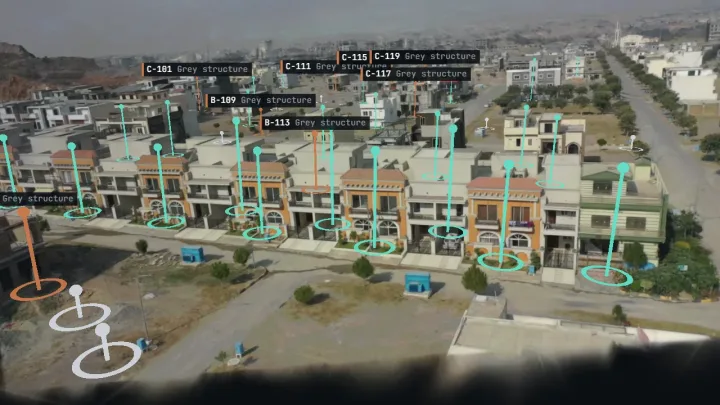
A photograph records what somebody chose to look at. A capture records the room.
That is the whole difference, and it is why this works. A walk-round does not require deciding in advance what will matter. The adjudicator can go and look at the skirting board that turned out to matter, from the angle they want, on the date in question.
What one walk-round actually produces.
Five to ten minutes in a flat, with a phone or a 360 camera, gives you a scene somebody can move through freely in a browser. Dated. Kept. Sent as a link.
The things that make it usable in a dispute are unglamorous: it opens with nothing to install, so an adjudicator or a tenant can actually see it; it is not listed or searchable, so it is not public; and the date is attached to the capture rather than written on it afterwards.
You can pin notes to the place they describe — a mark on a door, the meter reading, the state of a worktop — which beats a numbered list referring to photographs in an appendix.
The four other jobs it does.
The deposit case justifies it. These are what make it pay the rest of the year.
Briefing a trade without a visit. “Second bedroom, the radiator on the left” is a phone call and a misunderstanding. A link, with a pin on the radiator, is neither. For anybody managing property across a region this is the quiet winner.
Showing a void. An applicant who cannot attend gets to walk it instead of scrolling photographs, which filters out the people who were never going to take it and saves a Saturday.
Reporting to a landlord. Particularly one overseas, for whom the alternative is trusting a description.
Before and after a refurbishment. Two captures a few weeks apart is the clearest possible account of what the money bought.
Where it does not help, and say so early.
It does not replace the written inventory. A capture shows condition; it does not describe it, grade it, or sign it. The written document still does that work, and an inventory clerk still does it better than software. What changes is that the words now have something behind them.
It does not produce a publishable floor area. Scale is set after the fact. From the storeys of a building you land roughly 10 to 20 per cent out, which is useful for comparing one capture against another and nowhere near good enough for a listing. For a walk round on a phone we have not measured the error at all, so we set scale from a length you know on site and tell you the figure for that capture rather than quote somebody else’s. The surveyed number rules every time, and nothing here settles a boundary.
It does not fix bathrooms. Mirrors and glass are the hardest surfaces for a reconstruction, which is inconvenient given how often bathrooms are what the dispute is about. Photographs still earn their place there.
A record that overstates what it proves is worse than no record, because somebody will rely on it.
Making it a habit rather than a project.
The failure mode is familiar: capture three flats brilliantly, then stop. The value is entirely in having one for the property that turns out to be the problem, which is never the one you expected.
So the only version that works is the boring one. Capture at check-in and check-out as a matter of course, by whoever is already going. Keep every date. Do not decide which properties deserve it.
That is why we sell this as a record with a monthly plan rather than as individual jobs. A pilot is two captures a month apart so you can see the difference for yourself before committing to anything, and we quote both the pilot and the monthly in the same reply.
What this means for a buyer.
Start with the business decision, audience, and evidence the project must produce. Simam Digital can turn that into a focused discovery, prototype, MVP, or production roadmap across AI applications, SaaS platforms, digital twins, real-time 3D, XR, and interactive systems.