Four different things wear the same name.
If three suppliers offer you a “3D viewer” you will be shown three incompatible products. It is worth being able to tell them apart before you compare prices, because the differences decide whether the thing is useful to a buyer who cannot visit.
A photo tour. Stills, with arrows between them. Cheap, familiar, and no more informative than the gallery already on your listing.
A 360 tour. Spherical photographs taken from fixed positions. You can look around from each spot, and you can jump between spots, but you cannot walk between them — the viewer teleports. Good for showing a room exists. Poor at conveying how a flat flows, because flow is exactly the thing you are not allowed to do.
A scanned model. Geometry captured with a depth sensor, textured over. Measurable, and usually unmistakably synthetic: soft edges, missing glass, melted furniture. Fine for a floor plan, unconvincing as a thing to sell with.
A reconstruction from video. Ordinary footage, rebuilt into a scene somebody can move through freely in a browser. The technique behind most of these in 2026 is Gaussian splatting, which fits millions of small coloured blobs to the photographs until the result renders like the original. It looks like the place because it is made from pictures of the place.
The question that separates them is simple: can the person looking go where they want, or only where the camera went?
What a reconstruction is good at.
Three things, and they are the three that matter to somebody deciding whether to book a viewing.
It conveys space. A photograph taken with a wide lens flatters a room and everybody knows it, which is why buyers discount photographs. Moving through a scene at head height does not flatter anything.
It opens from a link. No app, no account, no store download. That sounds like a technical detail and is actually the entire difference between a thing people use and a thing people are asked to install.
It carries information where the information belongs. A price, a room size, a note about the boiler, pinned to the object it describes rather than listed in a PDF nobody opens. Our sample build of a commercial quarter does this at building scale, with a register of who holds each floor. The tenants in it are made up and the page says so.
What it is bad at, said plainly.
Any supplier who will not tell you this list is selling you something.
Glass, mirrors and gloss. A reconstruction works by finding the same physical point in many photographs. A mirror shows a different thing from every angle, so the software places points that do not exist. Bathrooms and glazed frontages are where these jobs go wrong.
Empty, featureless rooms. A freshly plastered white room gives the software almost nothing to match on. Furnished rooms reconstruct better than empty ones, which is the opposite of what people expect.
Anything that moved. People, pets, curtains in a draught, a tree in wind. If it moved between frames it will smear.
Measurement. This is the one that matters commercially, so it gets its own section.
The measurement limit, with real numbers.
A reconstruction has no inherent sense of scale. It knows the shape of a place and not its size, so scale is set afterwards by telling the software how big something in the scene is.
How well that works depends entirely on what you set it from. Our own measured figures:
| How scale was set | Roughly how close | What that is good for |
|---|---|---|
| From a length you already know, measured on site | Tightest of the three | Comparing one capture against another |
| From the storeys of a building in the scene | About 10 to 20 per cent | Seeing and comparing, nothing more |
| From the height the drone flew at, with nothing in frame to count | About 30 per cent | Impressions only |
| A walk round on a phone or 360 camera | We have not measured it | Set the scale from a known length and state the figure for that capture |
Ten to twenty per cent out is fine for “is this bigger than the last one”. It is nowhere near good enough for a floor area on a listing.
Where a figure matters legally or commercially — a floor area, a boundary, a lease plan — the surveyed number rules and a reconstruction does not replace it. We would rather say that here than after somebody has paid.
What it costs to keep, which nobody asks until later.
The question that decides whether this is worth doing is not what one costs. It is what happens when the property changes.
A tour shot room by room has to be reshot room by room. A reconstruction built from a single walk-round has to be rewalked, which is minutes rather than a morning. For a letting agency turning over the same flats repeatedly, that difference compounds into the entire business case, and it is the reason we sell the property version as a record rather than a one-off.
The other half is who holds it afterwards. Ask any supplier whether you get the scene files, whether it runs on your own domain, and what happens if you stop paying. A viewer that evaporates when a subscription lapses is a rental, however it was sold.
How to judge one in five minutes.
Open any supplier’s demo on a phone and run these.
- Walk where the camera did not go. If you cannot, it is a 360 tour.
- Look at a window and a mirror. That is where the reconstruction either holds up or falls apart.
- Count the taps to get in. Anything past the first one loses most of your audience.
- Ask what set the scale, and if the answer is vague do not use any number it gives you.
- Ask what a reshoot costs in time, not money.
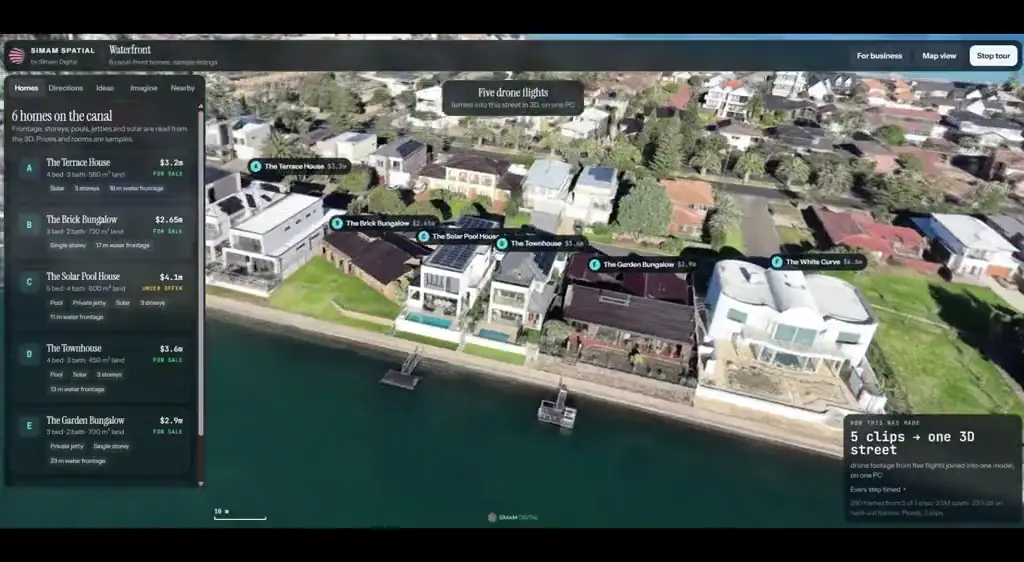
Ours are open without asking: a waterfront street where every home opens, and an apartment block with a unit finder. Both are sample builds of our own, with made-up listings, and each says so on screen.
What this means for a buyer.
Start with the business decision, audience, and evidence the project must produce. Simam Digital can turn that into a focused discovery, prototype, MVP, or production roadmap across AI applications, SaaS platforms, digital twins, real-time 3D, XR, and interactive systems.