Simam Repair Hub
A vehicle repair management platform for insurers and their bodyshop networks. Built end to end on .NET 10 and React by an engineer directing Claude Code agents: planned, coded, tested and deployed to AWS.
RJ-2026-0417 · estimate chaseOverdue 3 daysRJ-2026-0452 · parts on orderEstimate approvedOne live record for every repair
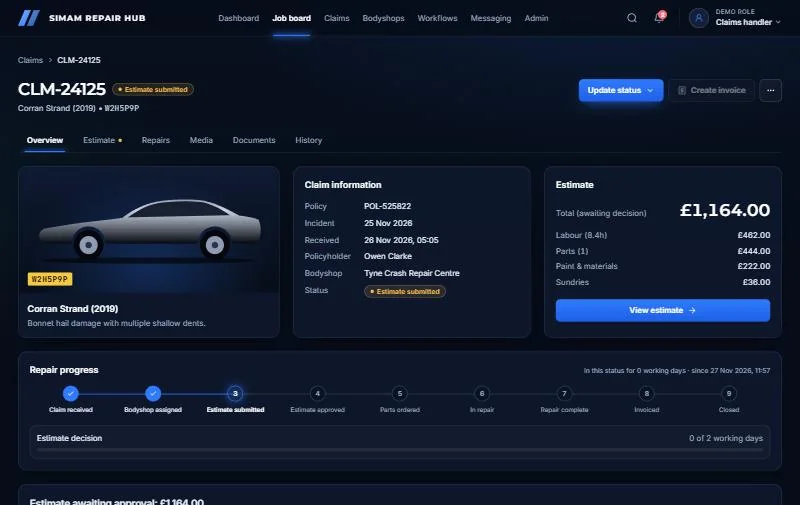
Insurers, repair coordinators and bodyshops work from the same job. Each one moves through a strict lifecycle: the system refuses out-of-order steps and flags anything falling behind its working-day SLA.
Insurers
Notify claims, choose a bodyshop, approve or reject estimates and see every job's cost and SLA at a glance.
Repair coordinators
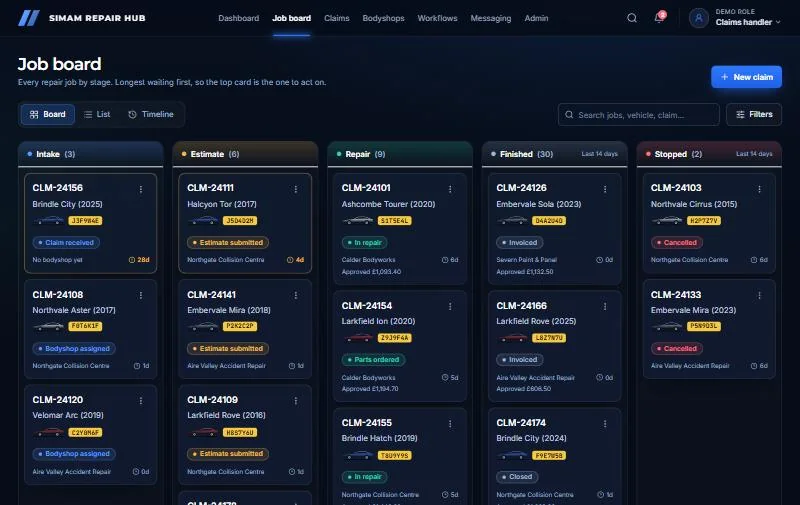
A Kanban job board with fuzzy search and an overdue filter that counts UK working days and skips bank holidays.
Bodyshops
Submit estimates, book appointments, record inspections and invoice, but only on the jobs assigned to them.
Architecture
What it is made of, and how it was decided.
One host, four stores and a queue, with every event saved alongside the data that caused it. The band across the top is the delivery method rather than the system: written requirements with acceptance criteria, decisions recorded before they were implemented, and each slice shipped green.
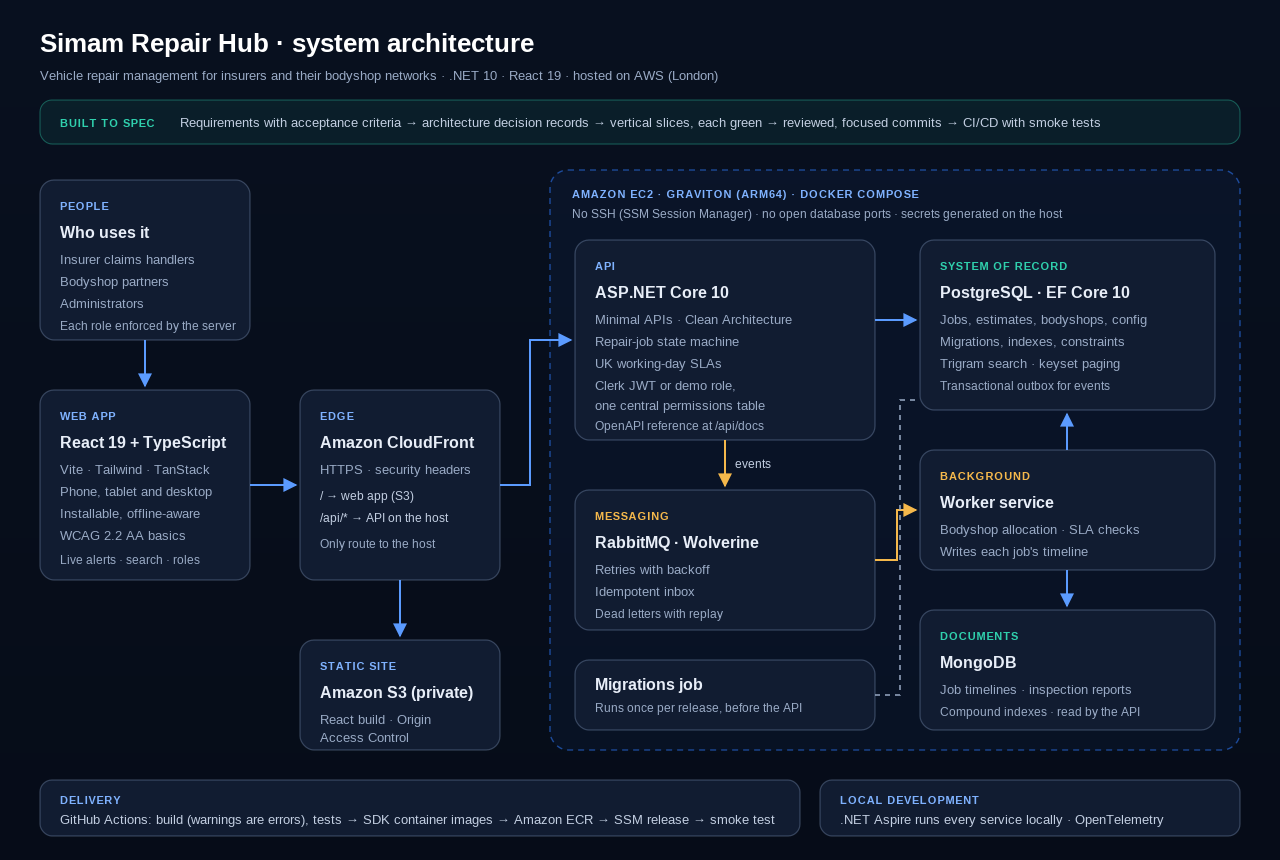
An engineer directing AI agents
Repair Hub was delivered with an agentic workflow in Claude Code. The engineer owns the brief, the guardrails and every review; agents do the planning, building, testing and shipping, each step checked before the next.
Brief and guardrails
Requirements written as Given / When / Then. Rules set up front: security, naming, cost limits, no deploy without approval.
Plan and decide
Agents research current versions and record six architecture decisions, each with options and trade-offs.
Build in slices
Five vertical slices, each ending green. Independent work runs in parallel agent sessions with agreed file ownership.
Verify and ship
Tests run, generated SQL inspected, images built and examined, releases smoke-tested through CI and AWS.
Agents catch their own mistakes when the workflow makes them prove each step: a deploy test that could never fail and a mis-scoped cloud permission were both found and fixed before release.
A modern .NET and React stack
The stack an enterprise .NET team runs today, on current long-term-support versions.
Platform
Domain state machine for the job lifecycle; plain, testable use-case handlers.
Orchestration
One command starts the API, worker, databases and broker locally with tracing and a live dashboard.
Data
Relational jobs and estimates in PostgreSQL; timelines and inspection reports as MongoDB documents.
Messaging
Events are saved with the data, delivered once to the worker, retried with back-off, and parked for replay if they fail.
Front end
Responsive, accessible screens for each role, driven directly by the API.
Cloud and delivery
CloudFront, S3, Graviton EC2 and ECR; CI on every push; scripted one-command releases and rollback.
Production habits, not a prototype
Inside the demo
Four screens, and what each one is for.
Open jobs, the decisions waiting, the stage every job is sitting in and what is past its working-day SLA. Every figure is read with real SQL over the demo database.

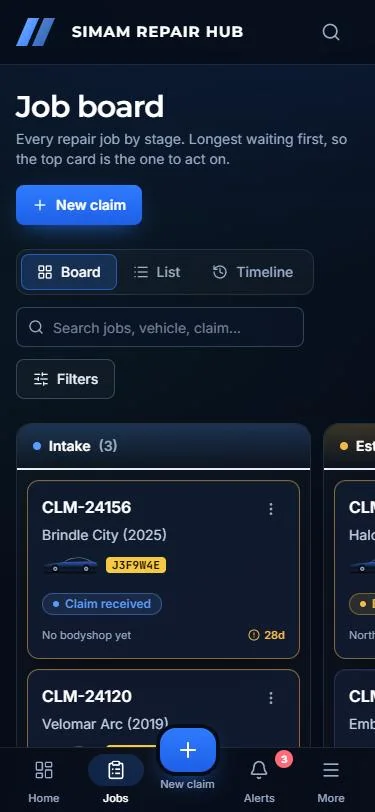
It has to work in a workshop.
A repair coordinator is standing next to a car, not sitting at a monitor. The same job board, the same permissions and the same search run on a phone, because a board that only works at a desk is a board nobody updates until the end of the day.
Demonstration data. Every claim, customer, vehicle and bodyshop in the application is invented.
See it running
Open the dashboard, search the job board, and follow a claim through its timeline. Switch role in the header to see the same job as a claims handler, a bodyshop or an administrator: each one is allowed different things, and the rules are enforced on the server rather than hidden in the screen. No sign-in needed.
Open the live demo Read the API referenceSource available on request. All vehicles, customers, insurers and bodyshops are fictional.