Simam AI Lab Our applied AI research division is now open. Visit the lab

Asset register

The register, and the thing it describes, in one place.

Most asset registers are a spreadsheet of names somebody typed, and the building is somewhere else. This one is the building: every vent, unit, pipe, pole and tree pinned where it actually stands, with its size, its condition, the photograph it was found in and the work raised against it.

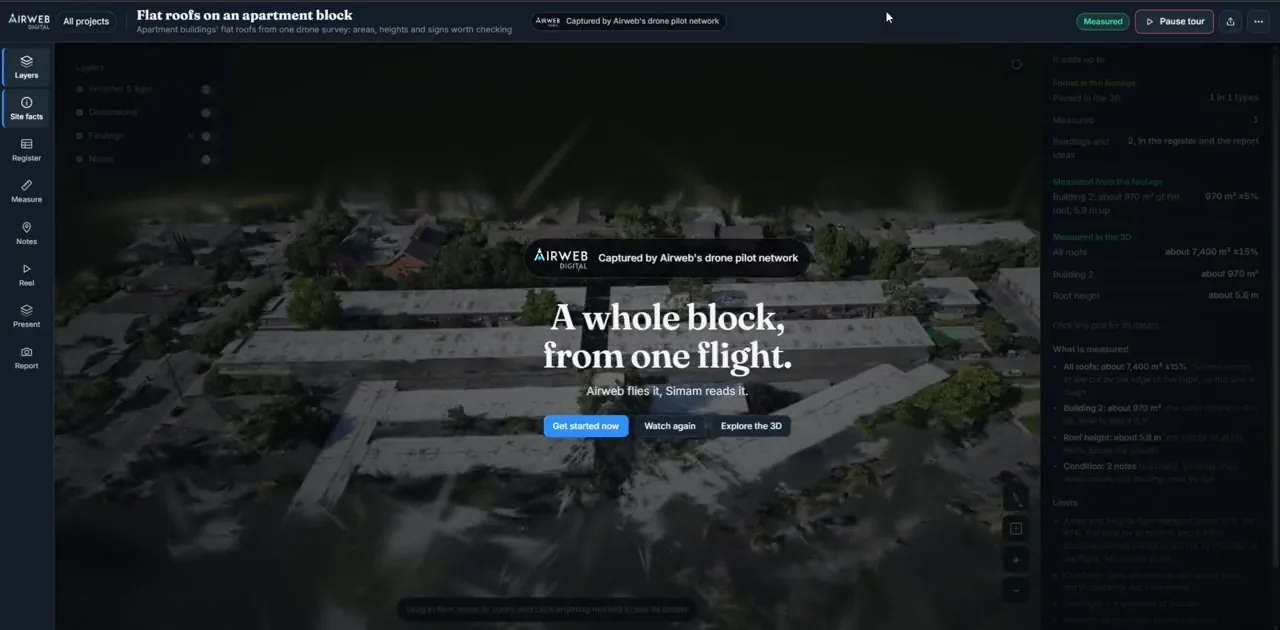
Flat roofs across an apartment block rebuilt in 3D, with their
        areas and heights measured

Captured by Airweb Digital’s drone pilot network. The flying, the pilots and the survey work are theirs: see their own work on their site. The site shown here is a sample and the register says so on itself.

The problem it was built for.

An asset register is supposed to be the answer to "what have we got and what state is it in". Most of them cannot answer either question without somebody going to look.

The list and the building are separate things

A spreadsheet of names somebody typed, and a site two hours away. Matching a row to a thing on a roof is a job in itself, and it is done again every time somebody new arrives.

Condition is whatever was last remembered

Without a date on it, "that one is fine" is an opinion with no shelf life. The first real check often happens after the leak.

Evidence lives in somebody’s phone

The photograph that proves it exists, in a thread, on a device, belonging to a person who has since moved on.

What it does.

What somebody opens it to do, rather than how it is made. We are not publishing the second part.

Every item is a thing, not a row

Open a vent, a unit or a pipe run and you get its size, how high it sits, when it was found and the photograph it was found in. The register and the evidence are the same object.

Condition, with a date on it

A grade and the date it was last checked, so "needs work" is a position in time rather than an opinion somebody remembers having.

Checks and work orders raised against the item

A check is recorded on the thing itself, and the work order that follows is attached to it. Nobody has to describe which vent they mean.

Notes and files where they belong

A note is dropped at a spot, and reports, photographs and documents hang off the asset rather than off an email thread.

An activity log and a weekly report

Every change, who made it and when, and a weekly summary of what moved: conditions that changed, checks done, work orders opened.

One list everybody reads

The surveyor, the facilities manager and the contractor are looking at the same register rather than three versions of it.

Two of them, moving.

Our own builds, captured by our drone pilot partner. The registers themselves are private and we open them with you on a call.

A whole block from one flight. Every roof measured with its margin printed next to it, not a tidy number on its own.
The same commercial roof run forward: after heavy rain, in spring, in winter. The seasons are marked on screen as imagined scenarios rather than captures, because that is what they are.

What the demonstration holds.

Every figure says what kind of figure it is, and every measurement carries its margin. That is the whole of why they can be used.

117assets on one commercial roof site

Counted. Rooftop mechanical, vents and fans, pipes, the roof surface itself, access, and the site around it: lighting, services, trees and vehicles.

292photographs behind that capture

Counted. One drone visit by our capture partner, nobody on the roof.

about 7,400 m²of roof across an apartment block, ±15%

Measured, and the margin is published with it because roof edges are where a figure like this goes wrong.

about 970 m²for one building in that block, ±5%

Measured. A single clean roof plane carries a tighter margin than a whole block, and saying so is the point.

about 5.8 meaves height, read off the 3D

Measured, with its own margin. Heights and lengths are taken off the 3D and each one carries its tolerance.

0people sent onto a roof to build the register

Checked against what the job actually involved.

Where this gets used.

These are the jobs the register gets asked to do in each place, not a list of places we are claiming clients in. No client is named on this page and none of the work shown here belongs to one.

the UK

Flat roofs, dilapidations and schedules of condition, school and housing estates, and insurers who want a dated record of a building before anything happened to it. The common thread is a building somebody is responsible for and has not been able to see properly.

the USA

Large commercial portfolios where one facilities team covers many sites, and nobody can walk all of them. A register per site, read from a desk, and a weekly report that says which of them moved.

the UAE

Towers and mixed-use estates under facilities management contracts, where the question at handover is what exactly is being taken on, and the question every year after is what condition it is in now.

Saudi Arabia

New estates and infrastructure coming into operation, where an operations team inherits something very large that has only ever existed as a drawing. The register is the first honest inventory of what was actually built.

South East Asia

Weather is the asset manager. Heavy rain, humidity and storm damage make the dated record the useful part: the same roof after the rain, beside the same roof before it.

Central Asia

Distance and winter. Sites that are a long drive from the people responsible for them and unreachable for part of the year, where a visit has to count and the questions in between still need answering.
What this is not.

A record, not a survey

Measurements read off a capture carry a margin, and we print it next to the figure rather than in a footnote. Where a surveyed figure exists, the surveyed figure wins, and nothing here settles a boundary, a quantity or a compliance question.

A condition grade is a prompt, not a verdict

It tells somebody competent where to look. It does not replace them looking, and it is not a structural or a safety assessment.

The seasons in the film are imagined

The app marks them on screen as imagined scenarios rather than captures, in amber, while they play. They show what a dated record would let you compare. They are not photographs of that roof in winter.

The sample content is sample content

The site in the demonstration is a sample, the grades and inspection dates are samples, and the register says so on itself. Your own register contains your own assets and nothing else.

No saving is claimed, because none was measured

The obvious thing to put here is the visits avoided or the hours saved. Nobody measured that on this job, so there is no figure and we are not inventing one.

Before you ask.

How does it get built?

From a drone visit, or from footage you already hold. What we will not publish is how the work is done after that, and you would not want us to: it is the part that took the longest to get right.

Who names the assets?

A person, from the photographs, and the register says so on each item. That is deliberate. A name nobody checked is a name nobody should rely on.

Can we keep it up to date?

Yes, by capturing again. The point of a dated record is the second one: two dates side by side is what makes a change visible rather than remembered.

Does it replace our FM or asset system?

No, and we would not suggest it. It is the picture and the evidence under what you already run. Tell us what you use and we will say plainly what is realistic.

Who can see it?

Whoever you give it to. These registers are private: there is no public link to this one and we open it with you on a call.

What does it need from us?

A site and permission to fly it, or footage you already have. We look first and tell you if it will not work before you commit to anything.

See one on a call.

A free fifteen minute call. We open a working register, you ask what you like, and we tell you plainly whether your site suits it. We come back to you with a time, so there is no calendar to wrestle with.