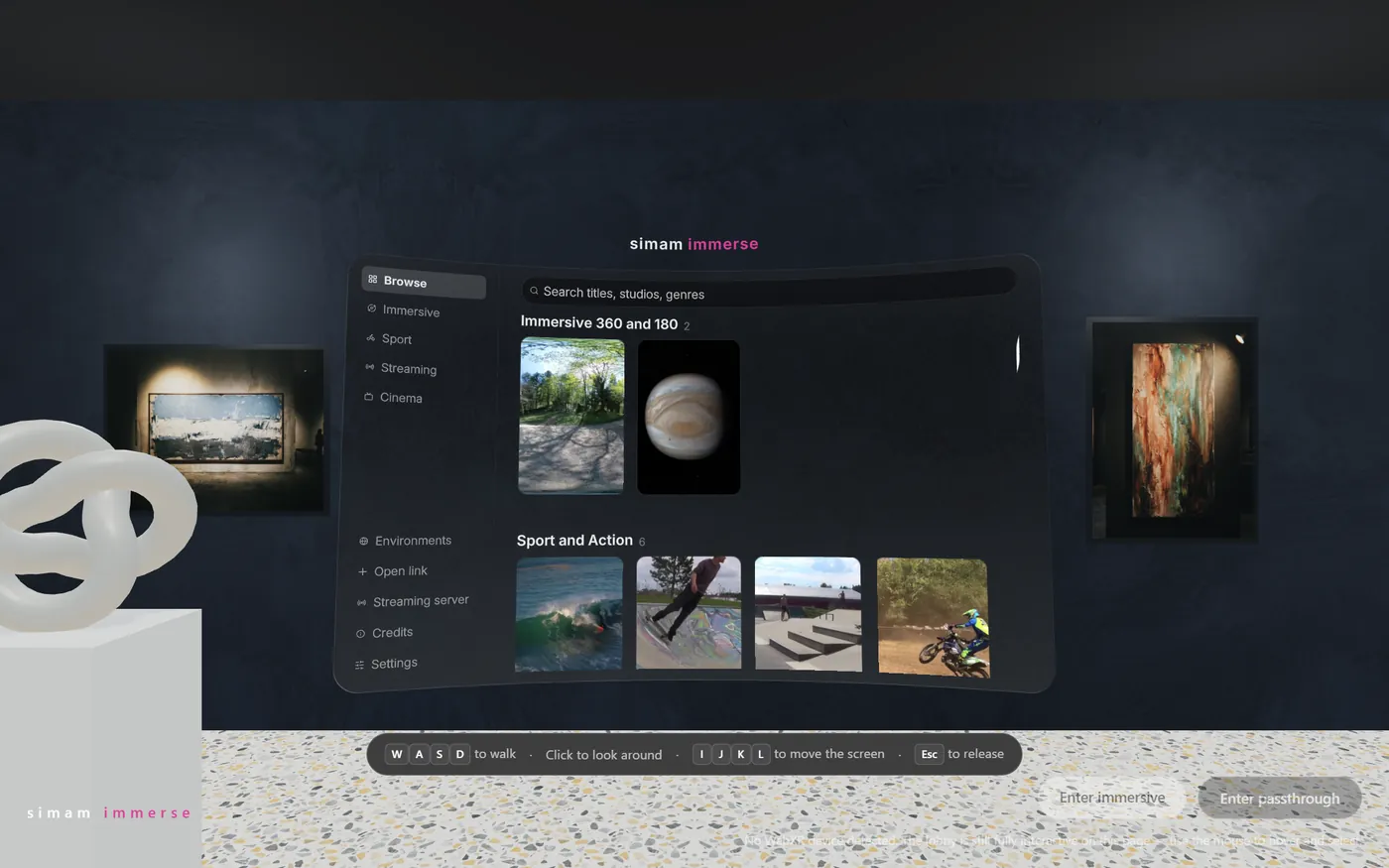
A headset, a URL, and a robot at the other end.
Strip away the branding and the arrangement is easy to state. Someone puts on a headset. They open a web address. They see a robot — or a simulation of one — in stereo, and when they move their hands the robot moves. No application was installed. No store was involved. The compute doing the hard work is in a rack somewhere else.
This is worth attention for a reason that has very little to do with XR as most people have encountered it. For a decade, immersive technology has been looking for a business to belong to, and has mostly been offered training, marketing and visualisation. Robot teleoperation is a different proposition, because it is not a nicer way to view something. It is the control surface for a machine.
A headset used to look at a digital twin is a display. A headset used to drive a robot is an input device, and input devices sit much closer to operations budgets than displays do.
It also arrives attached to a far larger narrative. Humanoid robots and physical AI are absorbing an enormous amount of investment and attention, and those systems need two things constantly: an interface for humans to operate them, and demonstration data for them to learn from. A person wearing a headset and doing a task correctly generates both at once.
How the loop actually closes.
The architecture is worth understanding precisely, because it explains both why this is possible now and where it will hurt.
  The teleoperation loop

  Headset (Quest 3, Pico 4 Ultra)
    browser opens a URL
    WebXR captures head pose
    WebXR captures hand tracking
        |
        |  input upstream
        v
  CloudXR runtime
        |
        v
  Isaac Lab, on server GPUs
    simulates the robot and scene
    renders STEREO views
        |
        |  encoded, low latency
        v
  CloudXR streams frames back
        |
        v
  Headset displays the result

  Nothing is installed on the headset.
  Nothing heavy runs on the headset.
  The headset is a sensor and a screen.
Two details in that diagram carry most of the consequences.
The headset is deliberately dumb. It contributes tracking and display and nothing else. That is why a consumer device costing a few hundred pounds can front a simulation that would need a workstation to run locally, and it is the same trade we have written about in CloudXR versus local rendering.
The network is inside the control loop. This is the part to take seriously. When a stream carries a video, latency is an annoyance. When it carries a person’s hands to a robot and the robot’s world back to their eyes, latency is the product. Everything about whether this works in your building is a network question, and it should be tested as one before anything else is decided.
Why the browser, rather than a native application.
The obvious objection is that a native headset application would be faster and more capable. It would. The browser wins on everything that is not performance, and in an operational setting that turns out to matter more.
Distribution. A URL. No store submission, no enterprise enrolment programme, no sideloading instructions emailed to a site manager. Anyone who has tried to get a native XR application onto managed devices inside a large organisation will recognise this as the difference between a pilot that happens and one that does not.
Updates. A fix is a deploy. Every headset has it at the next page load. Native XR fleets carry release management as an ongoing cost.
Device neutrality. CloudXR.js is described as working with any WebXR-compatible framework, which means the client is not a bet on one vendor’s headset surviving your procurement cycle. Given the history of this hardware category, that is not a small consideration.
It is the same stack as the rest of your software. NVIDIA ships a React Three Fiber example alongside the WebGL one, which means the teleoperation view can be built with the same components, the same state management and the same developers as the dashboard next to it. An XR capability that lives inside the web application your team already maintains is a fundamentally cheaper thing to own than a separate native product with its own release train.
What it is not yet, on the evidence.
This is where a technology radar earns its keep, because the demonstrations look effortless and the reality in the public record does not.
Access is gated. Quest 3 and Pico 4 Ultra support runs through an early access programme, and NVIDIA’s own developer forums carry a steady stream of people requesting access to the Isaac teleoperation samples. That is a perfectly normal stage for a technology to be at. It is not a stage at which you commit a delivery date.
The server side is a real installation. Isaac Lab wants Linux, Docker and the NVIDIA Container Toolkit, with dual-GPU configurations for best performance. That is an infrastructure project with an owner, not a piece of software somebody installs one afternoon.
Device and tracking failures are live issues. The forums carry concrete ones, including a Quest 3S teleoperation thread reporting no tracked devices and an XR_ERROR_FORM_FACTOR_UNSUPPORTED failure against a specific Isaac Lab and CloudXR combination. We link it below deliberately. A vendor page tells you what the technology does; a support forum tells you what it does on a Tuesday.
The stack is real, documented and supported. It is also early, gated and fiddly. Both halves of that sentence should survive into your planning.
Who this is genuinely for.
Being specific about fit, because the interesting technologies are the easiest ones to buy for the wrong reason.
| If you are | Is this relevant now? | Why |
|---|---|---|
| Running robotics simulation on NVIDIA infrastructure already | Yes | You have the server half. The browser client is an incremental addition to something you operate. |
| Collecting human demonstration data to train manipulation policies | Yes | A headset operator producing correct task executions is exactly the input these systems need. |
| Operating remote or hazardous equipment today with 2D controls | Worth a pilot | Stereo depth and hand tracking change what an operator can judge. Test latency on your network first. |
| Building an industrial twin for review and stakeholder work | Not this | You want the rendering architecture question, which we cover in our CloudXR for business leaders guide. |
| Exploring XR for training or marketing | No | Different problem, cheaper answers, no GPU infrastructure required. |
The pattern is that this is a robotics decision that happens to involve a headset, not an XR decision that happens to involve a robot. If your organisation has no robotics or simulation programme, this is a thing to know about rather than a thing to do.
What a sensible first step looks like.
If the first two rows of that table describe you, the first step is not a headset order.
- Measure the network on the path the loop would take. Not average bandwidth — latency and jitter, between where the operator would stand and where the GPUs are. This single measurement decides feasibility and costs nothing.
- Establish who owns the server side. Linux, Docker, GPU scheduling and a simulation environment need a named owner with time. Teleoperation pilots stall here far more often than they stall on the XR.
- Pick one task with a real operator. Not a demonstration scene. One task somebody does now, with the person who does it, so the comparison is against reality rather than against a slide.
- Decide in advance what would make it worth continuing. Faster? More accurate? Usable by someone less trained? Producing training data at a rate worth having? Write the number down before anyone is impressed by the demo.
That is a scoping exercise rather than a build, and it is the kind of thing our Idea Validation Sprint at £495 exists for. If it turns into a browser-side prototype, that work starts from £3,250.
Where we actually stand on this.
Clear lines, because robotics is a field where overclaiming is common and easily checked.
What we build in production: browser-based XR and real-time 3D, including WebXR experiences delivered from a link with nothing installed, and operational twins that connect 3D to live data. The client half of this architecture — WebXR, React Three Fiber, streaming into a browser, making a headset experience work without a store — is our daily work.
What we have written about the surrounding architecture: what CloudXR is and when it makes sense, and how remote rendering compares with local on cost and concurrency.
What we have not done: delivered a robot teleoperation system. We have not run Isaac Lab in production for a client, and we are not a robotics integrator. If you need the robotics half, you need a robotics partner; what we would bring is the browser client, the interface and the surrounding web application.
We are covering this because the browser becoming a control surface for physical systems is a genuinely significant direction for anyone building spatial software, and because the gap between the demonstration and the deployment is worth describing accurately before someone budgets against the demonstration.
What this means for a buyer.
Start with the business decision, audience, and evidence the project must produce. Simam Digital can turn that into a focused discovery, prototype, MVP, or production roadmap across AI applications, SaaS platforms, digital twins, real-time 3D, XR, and interactive systems.
Sources and further reading
- NVIDIA CloudXR.js SDK
- NVIDIA: Build and Stream Browser-Based XR Experiences with CloudXR.js
- Isaac Lab documentation: Setting up CloudXR Teleoperation
- NVIDIA Developer Forums: Quest 3S teleop, no tracked devices
- Isaac Lab: A GPU-Accelerated Simulation Framework for Multi-Modal Robot Learning
- W3C: WebXR Device API