The hardware question stopped being the hard part.
For most of the time people have been asking us about running AI privately, the honest answer involved a server, a graphics card with a number in it, and a conversation about where it would live.
That has largely gone away. In an August 2025 forecast, Gartner put AI PCs at about 31% of worldwide shipments for 2025 and about 55% for 2026, around 143 million units. Analysts count differently and the spread is worth knowing: Omdia has been nearer 50% on a looser definition, Counterpoint nearer 59% on a stricter one that requires more of the chip. Treat them as direction rather than precision. The direction is not in dispute.
What that means practically is that a business replacing laptops on a normal cycle is now buying machines that can run a small model without anybody deciding to buy AI hardware. The capability arrives as a side effect of procurement.
The machines arrived first. That is the opposite of the usual order, and it is why so much on-device AI capability is sitting idle in offices right now.
There is a familiar shape to this. The ONS found that the average AI-adopting UK business used about 1.6 distinct AI technologies, against about 1.4 nearly three years earlier: adoption that is wide and very shallow. On-device AI is heading the same way for the same reason. Having the capability is not the same as having given it a job.
Small models got good enough for the boring jobs.
The other thing that changed is less visible, because it did not happen in a headline release.
Open-weight model families now ship in sizes that fit an ordinary machine, and at those sizes they are good enough for the work most businesses would actually hand over. Not reasoning competitions. Finding which of forty documents mentions a clause, drafting a note from a template, summarising a site report, sorting incoming files into the right folder, pulling figures out of a stack of PDFs into one table.
These are the jobs that never justified an AI project because each one is too small, and collectively they are most of what people spend an afternoon on.
We wrote a reference list of the ten local AI model families worth knowing, and the advice in it has held up better than we expected: do not over-think the choice at the start. The gap between the right model and the wrong one is almost always smaller than the gap between a well-organised document set and a messy one. That was true when we wrote it and it is more true now that the small models have improved.
  Where the difficulty actually sits

  Choosing the model .......... 10%
    Several families are fine.
    Pick one, move on.

  Getting the documents in
  a state worth searching ..... 50%
    The part nobody budgets for.

  Making it safe to let near
  a real folder ............... 40%
    Permissions, approvals, checks,
    and a record of what happened.

  Projects fail in the bottom two rows
  and spend their first month on the top one.
Running it locally answers one question, and only one.
This is where local AI gets oversold, including by people selling local AI, so it is worth being exact.
Running a model on your own machine answers the question of whose building the data is in. Prompts, documents and outputs do not leave. For a law firm, a surveyor, a clinic, a defence supplier or anyone holding information under a client contract that forbids third-party processing, that is not a nice-to-have, it is the thing that decides whether AI gets used at all.
It does not answer anything else, and three claims in particular are not true.
It is not automatic compliance. The EU AI Act is organised around what a system is used for and what it must disclose, not around where it runs. The Article 50 transparency duties began on 2 August 2026 and were not deferred: they sit in Chapter IV, while the Digital Omnibus amendment, Regulation (EU) 2026/1744, in force from 27 July 2026, deferred parts of Chapter III. On the Commission’s own timeline, standalone high-risk obligations under Annex III moved to 2 December 2027 and product-embedded systems under Annex I to 2 August 2028. Providers of generative systems already on the market before 2 August 2026 have until 2 December 2026 for the machine-readable marking duties under Article 50(2). A model running on a laptop in your own office is inside all of that, exactly as a cloud model would be. The Commission has published guidelines on the transparency obligations, and they are worth half an hour.
It is not automatically cheaper. It removes a per-token bill and replaces it with hardware you already own plus the time of whoever keeps it working. For steady everyday use that trade is usually good. For occasional use it frequently is not.
It is not automatically correct. A private wrong answer is still a wrong answer, and the privacy argument has a way of quietly standing in for a quality argument.
Local answers “whose data is this”. It does not answer “is this right”, “what must I disclose” or “what happens when it is wrong”. Those are still yours.
The failure that matters is not a wrong answer.
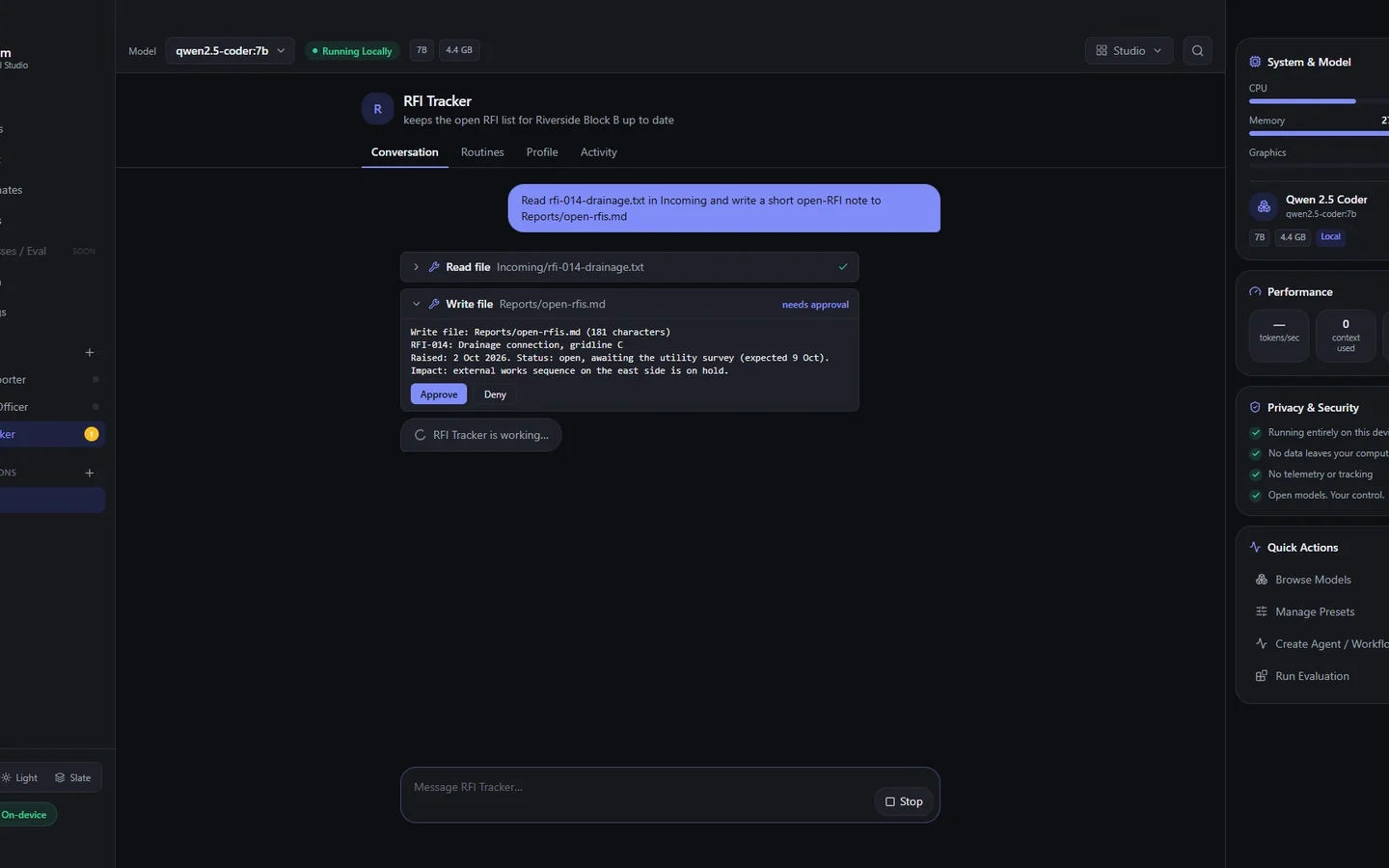
We have spent 2026 building a local AI assistant that works through the documents in a folder on a Windows PC, and the single most useful thing we learned is that the dangerous failure is not the one people expect.
Everyone worries about hallucination in the sense of a made-up fact. In practice the failure that breaks trust is narrower and worse: the model says it did something, and it did not. It replies that a daily note has been written to a reports folder, in a confident sentence with a plausible filename, and the folder is empty.
That happened to us in a live session on 6 October 2026. It is recorded, with the date, in the case study, along with four other problems that changed the design.
A wrong fact gets caught by the person reading it. A false report of an action gets caught weeks later, by which point nobody trusts anything the tool has said. The fix is not a better model. It is three things outside the model:
Ask before acting
Anything that writes to disk or runs a command stops and shows what it intends to do, in full, before it does it. Not a summary of the change: the content. A person says yes. This is slower and it is the whole basis of being willing to point it at a real folder.
Check the claim, do not believe the sentence
When the model reports that it wrote a file, the system goes and looks. If the file is not there, the claim is corrected before the user ever sees it. This sounds obvious and almost nothing does it, because it means treating the model’s own account of its work as a claim rather than as a result.
Keep a record
Every tool call, every approval, every refusal, written down and readable afterwards. This is what makes the difference between a tool somebody experimented with and a tool a business can account for.
What we publish about our own, and what we have withdrawn.
There is a number we would like to put here and are not going to.
We test reliability with a fixed harness: five everyday file tasks in a fresh folder, five runs each, with every failing attempt printed so that a crashed engine shows up as errors rather than as a bad score. The bar for recommending a model to do real work is 80%, and the application will not suggest a model below the bar.
In October a model scored 24 of 25 on that test. It is a good number and we are not quoting it as current, because it was measured against a model engine the application is now replacing, so it does not describe what will ship. The case study withdrew it and says plainly that no current score is published and that it is being re-measured.
A benchmark that no longer describes the thing you are selling is not evidence. It is decoration with a number on it.
We are saying this in a post whose purpose is partly to find beta testers, which is the point at which the temptation to leave the number in is strongest. If a local AI vendor shows you a reliability figure, the useful questions are when it was measured, on what hardware, over how many runs, and whether the thing being sold is still the thing that was tested. Our test ran on one machine, an Intel Core i9-11900KF with an NVIDIA RTX 4070 and 32 GB of RAM, over five tasks. That is a narrow test, and passing it proves the tool was used correctly, not that the writing was any good.
Simam Local LM, and how to get into the beta.
Simam Local LM is a Windows desktop application that gives a local model a folder, a set of permissions and a record of everything it did. It downloads and manages its own model engine on a private local port and stops it when you close the app. Models are open-weight files on your disk. There is no account, no telemetry and no cloud fallback, and if the model cannot do something locally it does not quietly reach for a cloud tool.
It can be triggered by chat, on a weekday schedule, at an interval or when a folder changes, which is the difference between an assistant you open and one that has a standing job.
What it does not do is as deliberate as what it does. There is no hosted version. It does not read a folder you have not given it. It does not write or run anything without asking. Commands stop after two minutes, including processes they started. And it is a beta: it has been exercised on a demonstration construction document set, not across a hundred customer estates.
What the beta involves
We are looking for a small number of businesses that will point it at a real document folder of their own and tell us what happens: which tasks it completes unaided, how often an approval gets declined and why, and whether smaller models hold up on the hardware you already have. In return you get the build, the help to set it up, and a direct line to the people who wrote it.
There is no download page and no sign-up form that drops a file at you, which is deliberate: this is a build we want to put into the right hands with a conversation attached. Tell us what folder you would point it at, or email sales@simamdigital.com, and we will reply with what it would and would not do for that work. If the honest answer is that a cloud tool would serve you better, we will say so.
What this means for a buyer.
Start with the business decision, audience, and evidence the project must produce. Simam Digital can turn that into a focused discovery, prototype, MVP, or production roadmap across AI applications, SaaS platforms, digital twins, real-time 3D, XR, and interactive systems.
Sources and further reading
- Gartner: AI PCs forecast to represent 31% of the worldwide PC market by the end of 2025
- European Commission: timeline for the implementation of the EU AI Act
- European Commission: guidelines on transparency obligations under Article 50
- Digital Omnibus on AI, Regulation (EU) 2026/1744
- ONS: Artificial intelligence in UK businesses, 2023 to 2026