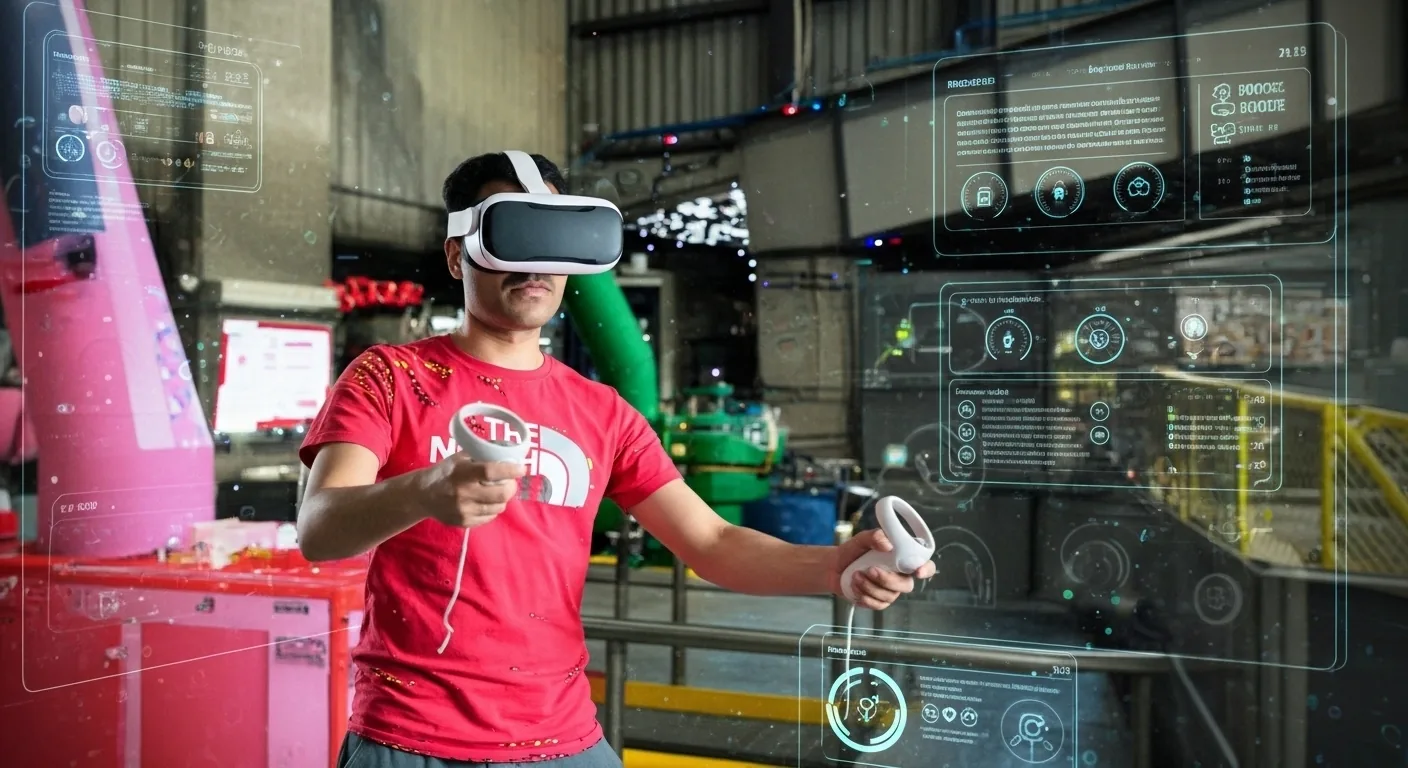
The market has become more honest.
The broad promise that every organisation needed a metaverse has faded. That is healthy. Hardware platforms are still evolving, but buyers now ask better questions: who will use this, where, how often, and what does immersion do better than a screen?
Developer discussion in 2026 is understandably cautious about consumer storefront economics and discoverability. At the same time, Google reports more than 100 applications built specifically for Android XR, while the W3C published a new WebXR Candidate Recommendation Draft in March 2026. The platform story is becoming broader even as individual business models remain uneven.
Four areas with credible momentum.
Android XR and spatial applications
Android XR combines familiar Android distribution with immersive features, hand and eye tracking, persistent spatial layouts, and Gemini-assisted interaction. It gives developers another path beyond a single headset ecosystem.
WebXR and frictionless demonstrations
Browser delivery is valuable for stakeholder reviews, product showcases, spatial portfolios, and lighter experiences where asking a user to install an application would kill engagement.
Training, simulation and familiarisation
XR remains compelling when spatial behaviour matters: hazard recognition, equipment procedures, vehicle scenarios, rehearsals, and environments that are costly or unsafe to reproduce.
Events, venues and branded installations
On-site activations have a known audience, staff support, controlled hardware, and a clear moment of use. They can combine VR stations, tablet experiences, mobile interaction, multiplayer games, and live leaderboards.
What has changed for product teams.
Cross-platform planning matters more. Unity and OpenXR remain strong for deep interactive applications; Android tooling opens spatial app patterns; WebXR offers low-friction reach; and conventional web or mobile may still be the correct companion surface.
The best experience may be a system rather than a headset app: a control dashboard, audience display, tablet operator interface, and immersive client working together.
How to decide whether XR is justified.
- Does depth, scale, embodiment, or spatial rehearsal materially improve understanding?
- Is the audience controlled, reachable, and supported?
- Can the experience be tested safely and comfortably?
- Would a web, tablet, or video experience achieve the same outcome for less?
- Who maintains content and hardware after launch?
If the answers are weak, do not force XR. If they are strong, immersion can make an idea obvious in a way a slide deck cannot.
What this means for a buyer.
Start with the business decision, audience, and evidence the project must produce. Simam Digital can turn that into a focused discovery, prototype, MVP, or production roadmap across AI applications, SaaS platforms, digital twins, real-time 3D, XR, and interactive systems.