The two numbers everyone quotes, and who paid for them.
Almost every immersive training business case in circulation rests on two studies. Both are worth knowing properly, including their limits, because the limits are where your own numbers will differ.
PwC’s soft skills study. New managers across twelve locations took the same inclusive leadership training in one of three formats: classroom, e-learning, and VR. The reported results are that VR learners completed the training four times faster than in the classroom and 1.5 times faster than e-learning; were 275% more confident in applying what they had learned; felt 3.75 times more emotionally connected to the content than classroom learners; and were four times more focused than e-learners. On cost, VR reached parity with classroom training at 375 learners and with e-learning at 1,950, becoming roughly 52% cheaper per learner at 3,000.
Forrester’s Total Economic Impact study of Meta Quest. Commissioned by Meta and published in 2025, it models 219% ROI, $6.1M of benefits and $4.2M net present value over three years. The mechanism is time: task-worker training up to 75% faster, saving around 24 hours per user per year; knowledge-worker training up to 50% faster, saving around 16 hours; and a 50% reduction in travel and on-site training costs, about $1.7M over the three years.
Now the part that usually gets left out. Forrester’s figure describes a composite organisation — 10,000 employees, $1bn revenue — assembled from interviews with six decision-makers at four companies. That is the standard, disciplined TEI method and it is not a criticism. But a composite is a model, not a measurement, and it was paid for by the company selling the headsets. PwC’s study, likewise, was PwC measuring PwC’s own training programme.
Neither study is dishonest. Both are marketing. Use them to check whether your own model is in the right postcode, not to replace it.
The number you should delete from your deck.
Somewhere in most immersive training proposals is a claim that people remember 10% of what they read, 20% of what they hear, and 75% or 80% or 90% of what they do — usually drawn as a pyramid, often attributed to the National Training Laboratories or to Edgar Dale’s Cone of Experience.
Those percentages have never had a source. Dale never put numbers on his cone; he built it to describe kinds of mediated experience, not to rank retention. The numbers were attached later by other people, propagated by repetition, and have been traced back through decades of citations that lead nowhere.
This is not a fringe view. Subramony, Molenda, Betrus and Thalheimer published a four-article series in Educational Technology in 2014 examining the myth’s origins and every previous attempt to kill it, and Letrud and Hernes published a further excavation of its origins in 2018. The evidence against the figures is not mixed; it is that they were invented.
Two reasons to care commercially. First, a business case built on a fabricated statistic is a business case that collapses the moment anyone checks. Second, and more damaging, the learning and development people you are pitching to increasingly do know this — and once one number in a deck is exposed as folklore, every other number in it gets discounted too.
The genuine argument for immersive learning does not need it. Practice under realistic conditions, in situations that would be dangerous, expensive or impossible to stage, is defensible on its own terms.
The variable that actually decides it is learner count.
Immersive training and classroom training have opposite cost shapes, and everything else follows from that.
A VR programme is nearly all fixed cost: the build, the content, the assessment design, the hardware. Delivering it to the 900th learner costs almost nothing more than delivering it to the 90th. Classroom training is nearly all marginal cost: a trainer’s day, a room, travel, and the wages of everyone sitting in it, paid again for every cohort.
| Immersive | Classroom | |
|---|---|---|
| Where the money goes | Build, content, assessment design, hardware | Trainer time, venue, travel, learner time |
| Cost of one more learner | Near zero | Roughly the same as the last one |
| Cost of one more location | Shipping a headset | A trainer’s travel and time |
| Cost of changing the content | Significant — a development cycle | Low — edit the slides |
| Gets cheaper with | Scale and repetition | Nothing |
That is the whole of the PwC parity finding, expressed as structure rather than as a statistic. It is also why every honest answer to “what is the ROI of VR training?” begins with a question: how many people, over how long? Below the crossover the answer is genuinely no. Well above it, the answer is genuinely yes, and it stops being close.
The row that ends programmes is the fourth one. Content that changes every quarter turns a fixed cost into a recurring one and quietly moves the crossover out of reach. If the procedure is still being argued about, it is too early to build it.
Where it pays, and where it does not.
Stripped of the vendor framing, the cases divide cleanly.
| Immersive earns its cost when | It probably does not when |
|---|---|
| The real thing is hazardous — you cannot rehearse an ammonia release | The cohort is small and stays small |
| An error is expensive, injurious or unrecoverable | The content changes every few months |
| Rehearsing means taking a real asset out of service | The material can simply be read |
| The workforce is dispersed and travel is the real cost | The bottleneck is scheduling, not delivery |
| Turnover is high, so the same training runs forever | Nobody has agreed what “competent” means yet |
| You need evidence of competence, not attendance | The goal is mainly to look innovative |
The last row on the left is the one that gets underrated. A classroom sign-in sheet records that someone was present. A well-built simulation records what they actually did, step by step, and that difference is often worth more to a safety or compliance function than the training time saved.
What we have learned building it.
One decision has mattered more than any other on the industrial training we have delivered: assessment has to be specified in the same document as the procedure, at the same time.
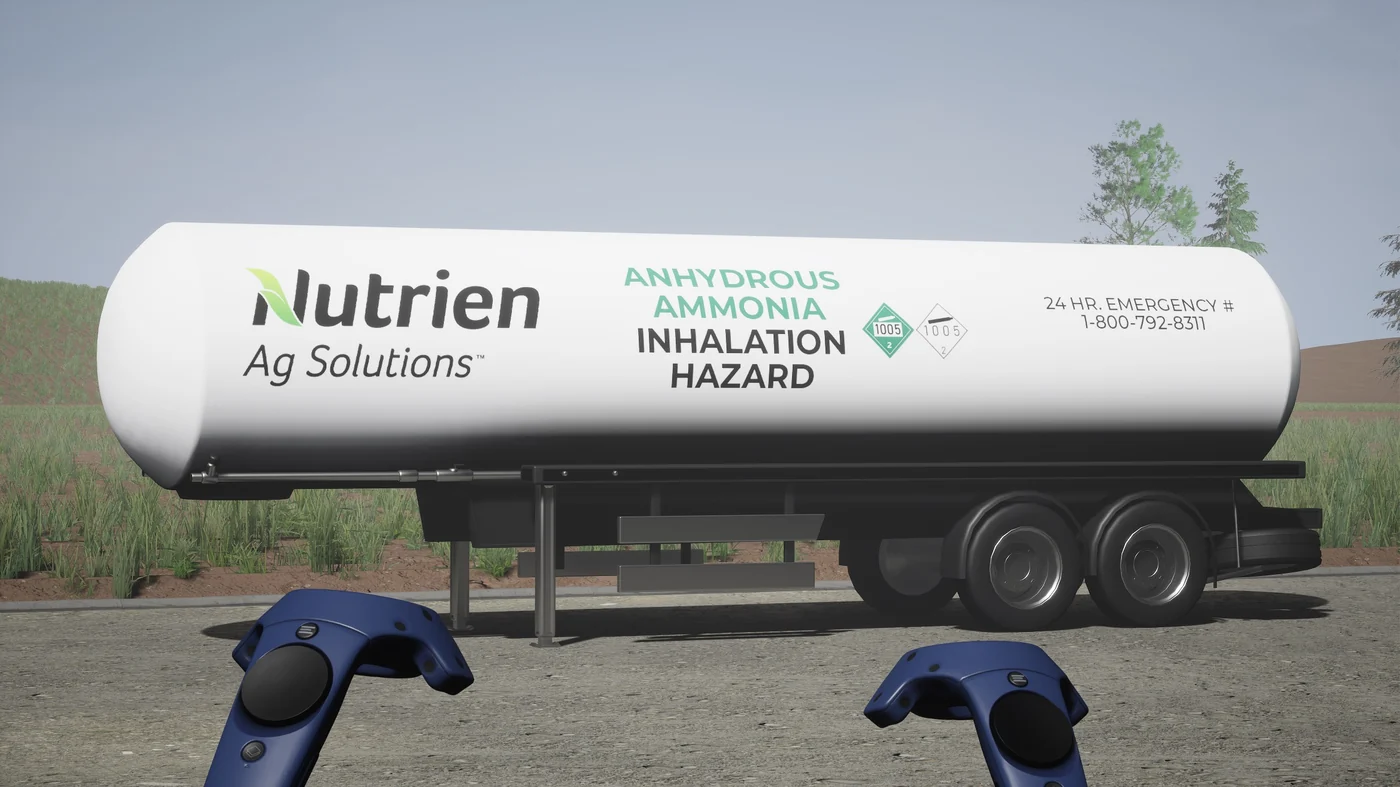
On an anhydrous ammonia transfer trainer, the client’s procedure sheet did not stop at the steps. Against each one sat what the system had to be able to observe: whether the learner had looked at the windsock, as a boolean; the state of the water tank as three separate checks rather than one; a valve position as a percentage rather than open or closed. That is an unglamorous spreadsheet, and it is the reason the finished product can produce a competency record instead of a completion tick.
Without it you have an experience. An experience is genuinely worth something — people remember it, it changes how they talk about risk — but you cannot compute a return on it, because there is no output to measure. Teams that leave assessment until after the environment is built almost always end up retrofitting it badly or dropping it, and then the business case has nothing to point at in year two.
The second lesson is narrower and cheaper: decide the hardware before the interaction design, not after. A tethered PC VR headset and a standalone headset lead to different content budgets, different room requirements and different rollout logistics, and reversing that decision late is expensive in a way that looks avoidable in hindsight.
A business case that survives contact with finance.
- Count learners over three years, not one. The fixed-cost shape means a one-year view will almost always say no, and almost always for the wrong reason.
- Price what you are replacing, honestly. Trainer days, venue, travel, learner wages for the hours spent, and the cost of taking a real asset or line out of service. That last item is frequently the largest and is routinely left out.
- Define the measurable output before the build. Write it next to the procedure, step by step. If nobody can say what the system should record, the ROI conversation has nowhere to land.
- Budget the second year. Content changes, hardware refreshes, and someone has to own it. A programme with no year-two owner quietly dies at the first procedure update.
- Use the vendor studies as a sanity check. If your model says 900% ROI in eight months, it is wrong. If it says a small negative for a 4,000-learner rollout, that is wrong too. Published figures are useful for spotting your own errors.
- Pilot with the worst cohort, not the keenest. The site with the incident record produces evidence. The site that volunteered produces enthusiasm, which nobody in finance accepts as a number.
Immersive learning in 2026 is not a bet any more; the mechanism is well understood and the cases where it works are known. What has not changed is that it is a capital decision dressed as a training decision, and it should be argued in those terms.
What this means for a buyer.
Start with the business decision, audience, and evidence the project must produce. Simam Digital can turn that into a focused discovery, prototype, MVP, or production roadmap across AI applications, SaaS platforms, digital twins, real-time 3D, XR, and interactive systems.
Sources and further reading
- PwC: How virtual reality is redefining soft skills training
- PwC UK: study into VR training effectiveness
- Forrester Total Economic Impact study of Meta Quest
- People don’t remember 10%, 20%, 30% — not even on a cone
- Letrud & Hernes: Excavating the origins of the learning pyramid myths
- Work-Learning Research: learning myths