The order is the safety
Checks come before connection, connection before valves, valves before transfer. A trainee who learns the steps out of order has learned the wrong procedure.
A virtual reality training application for anhydrous ammonia transfer — connecting and disconnecting a road tanker — delivered for Nutrien Ag Solutions with Myriad Global Media. Three modes: train, practice, assess. The interesting part is not the simulation. It is that every safety check the trainee performs, or skips, comes back as structured data.
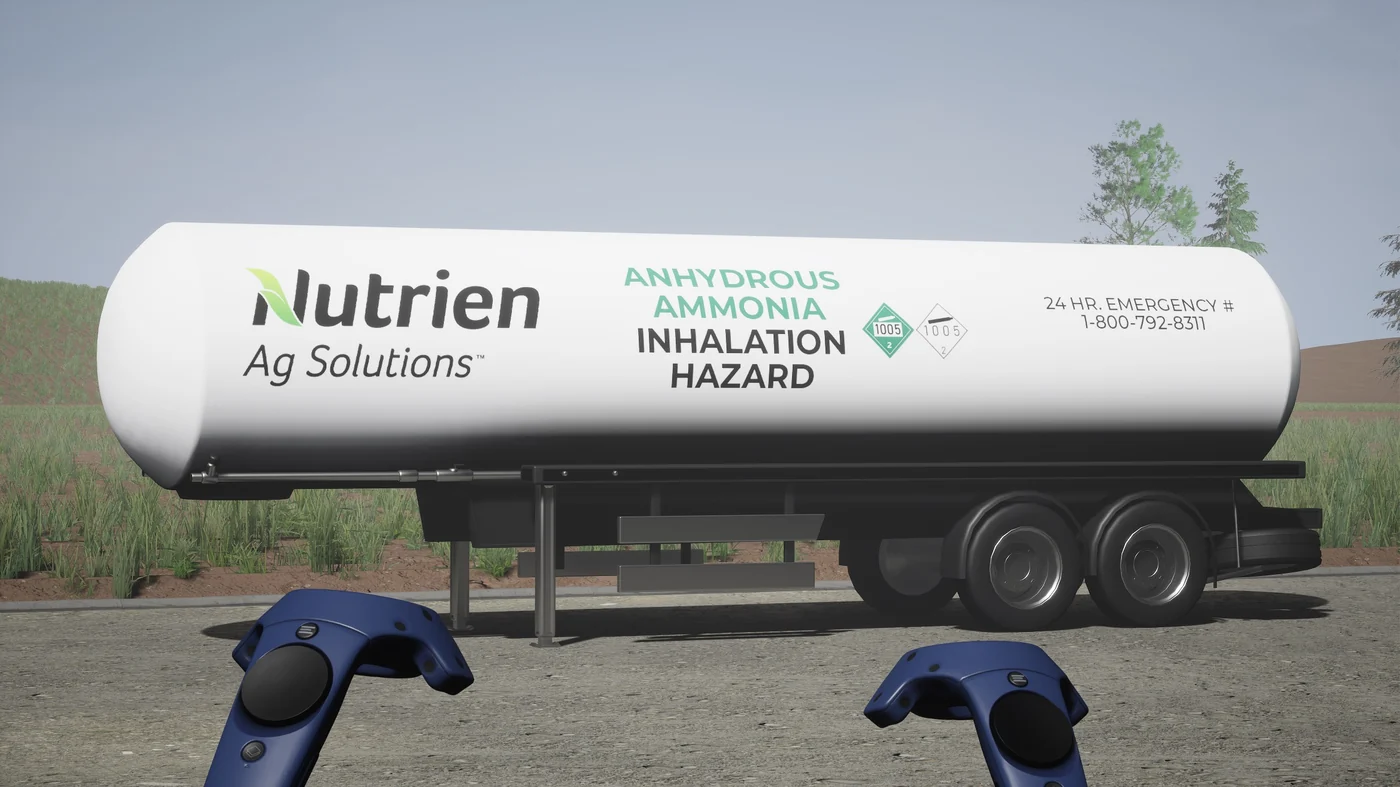
Anhydrous ammonia is labelled an inhalation hazard for good reason. The transfer procedure is full of checks whose value only shows up when they are skipped: the direction of the wind, whether your exits are clear, whether the safety water tank is actually full. Classroom training can describe them. A real tanker cannot safely let someone get them wrong and find out.
That gap is the case for VR in industrial safety, and it is narrower than vendors usually claim. It applies when the procedure is physical, the sequence matters, and the consequence of error is severe enough that nobody will let a trainee experience it. Ammonia transfer sits squarely inside all three.
Checks come before connection, connection before valves, valves before transfer. A trainee who learns the steps out of order has learned the wrong procedure.
The failure modes are chemical exposure and uncontrolled release. There is no low-stakes version of this on live plant.
Did they look at the wind sock? Did they check the water level? In a headset those are answerable questions. On a real site they are a supervisor’s recollection.
The application was specified as a signed-off step model: each step carrying its scene, description, voiceover and captions, on-screen UI, the assistance offered, the action required, sound, transition, and — the column that made the product work — what to measure.
Check the wind sock and read the direction. Confirm exits are open for egress based on that wind direction. Verify the safety water tank is present, full and clean. Open the lock boxes holding the hose end valves — yellow for vapour, orange for liquid.
The trainee meets a dummy in basic overalls with the correct PPE laid out beside it, and has to equip each piece. Ammonia suit, steel cap boots, water bottle, and the portable query and emergency stop are each tracked separately rather than as one “wore PPE” tick.
Open the valves slowly, check the gasket and connection for leaks, then open both fully. Prove the connection and check again — because a hammer that did not tighten properly and a gasket that did not seat properly both look fine until they do not.
The disconnect module ends where a real shift does: verifying site security before leaving, starting with removing the wheel chocks from the truck.
Most corporate VR training reports one number: did they finish. This was specified so that each step declares what it captures and in what type — and those declarations are unusually specific.
Recorded as a boolean. A trainee can walk past a check and complete the module; the data still knows they did not perform it.
Looked at the water tank, checked the water level, checked it was clean. Modelled as three separate observations, because a trainee who glances at a tank has not inspected it.
“Open slowly, then fully” is not a binary, so it is not stored as one. The valve state is captured as a percentage alongside the leak check.
Location checks carry a timestamp, so the sequence and pace of a session are reconstructable rather than inferred.
User login with session start time, so a record attaches to an individual and a date rather than to a headset.
The same procedure model drives guided teaching, unguided rehearsal and scored assessment. Assistance — highlighting the wind sock, the exits, the lock boxes — is a per-step property that the mode turns down rather than a separate build.
What this proves: when the assessment model is designed alongside the procedure rather than bolted on afterwards, a training build stops being a memorable experience and starts being defensible evidence of competency — which is what a safety manager actually needs to sign.
The build is worth commissioning when the sequence is physical, the consequence is severe, and someone needs evidence that a person can actually do it. If that is not your situation, a video is cheaper and we will say so.