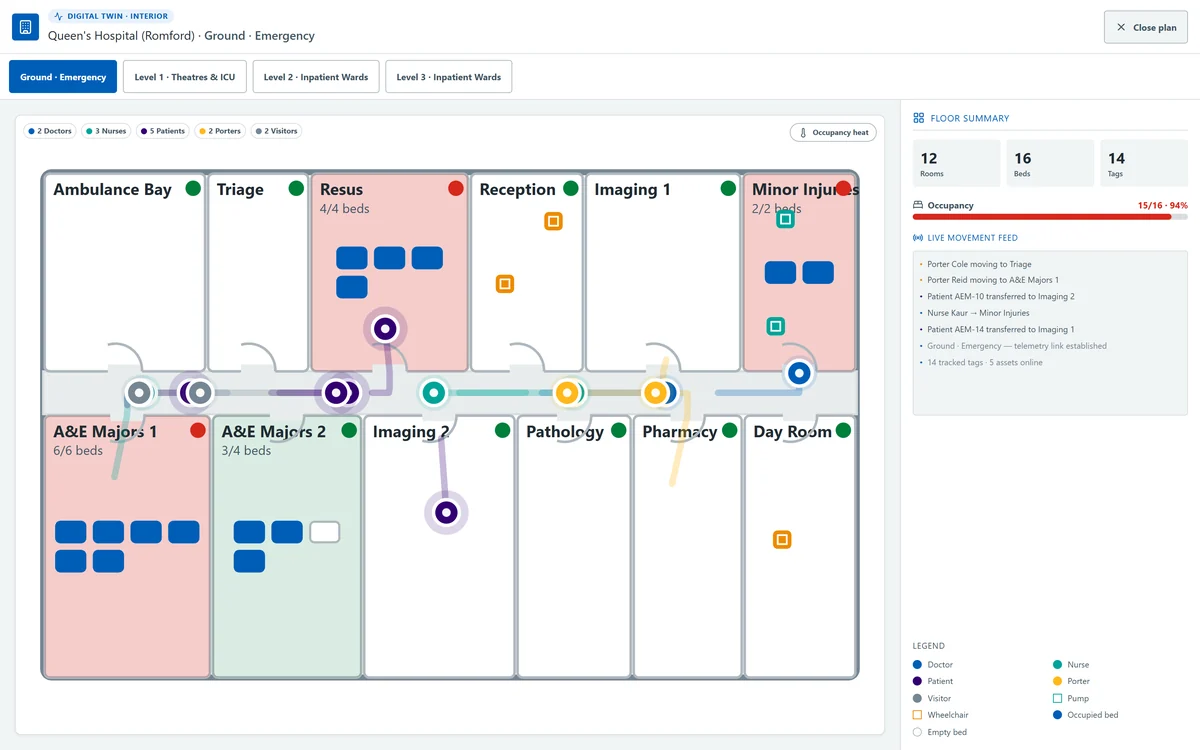
Healthcare operations is a scale problem before it is a data problem.
Anyone running a hospital or a wider health system is asked to reason at three scales at once. Where is demand concentrated across the region, and which sites are under pressure? What is this hospital's occupancy and emergency department status right now? And on this ward, where are the beds, the equipment and the bottleneck?
In practice those three questions live in three or more different systems: a mapping or estates tool for geography, a business-intelligence dashboard for performance, a bed-management system for occupancy, and spreadsheets for whatever falls between them. Each is defensible on its own. The cost lands on the person expected to hold them in their head simultaneously, usually while something is going wrong.
Nobody can see the system as one continuous object, from the region down to the corridor.
That is the gap a twin is actually for. Not a prettier building model — one continuous surface where moving from a national view to a single bay does not mean changing tool, losing context, or re-establishing which site you were looking at.
If it does not speak the operator’s language, it is a demo.
An audience of operations staff does not judge a twin on its graphics. They judge it on whether it can express pressure in the terms they already work in — and if it cannot, the conversation ends politely.
In a UK context that vocabulary is well defined and public. Escalation is described by the national OPEL framework, running from OPEL 1 to OPEL 4. Emergency performance is measured against the four-hour standard and twelve-hour waits. Flow out of a hospital is dominated by patients who are medically ready to leave but cannot — delayed discharges — which then block the beds an emergency department needs, which then shows up as ambulance handover delay. These are causally linked, and a twin that shows one without the others is telling half a story.
The practical test is whether the numbers reconcile. If a national view claims a level of pressure that the site views do not add up to, nobody in the room will trust any of it again. Internal consistency matters more than precision here: an operations audience will forgive modelled data in a prototype, but not arithmetic that contradicts itself.
The newest answer to that vocabulary problem is to stop making the operator learn an interface at all. We have since added a live voice assistant to the prototype, so a duty manager can ask which site is worst off and have the map take them there while the answer is still being spoken. What that took to build properly — the credential boundary, and why grounding the answers was harder than the wiring — is a separate piece.
A twin earns its cost when it changes a decision.
The distinction worth holding onto is between a lagging view and a leading one. A dashboard reports what happened. It answers the questions its designer anticipated, and it cannot answer the one you actually have at two in the morning.
A leading view converts the same picture into a recommendation and shows its reasoning. Take ambulance conveyance. The obvious answer is always the nearest emergency department, and a map will happily tell you which that is. But if the nearest department is saturated, a long handover delay can cost more time than a slightly longer drive — so the right destination is sometimes the second or third nearest, and the case for that is impossible to make from a list of distances.
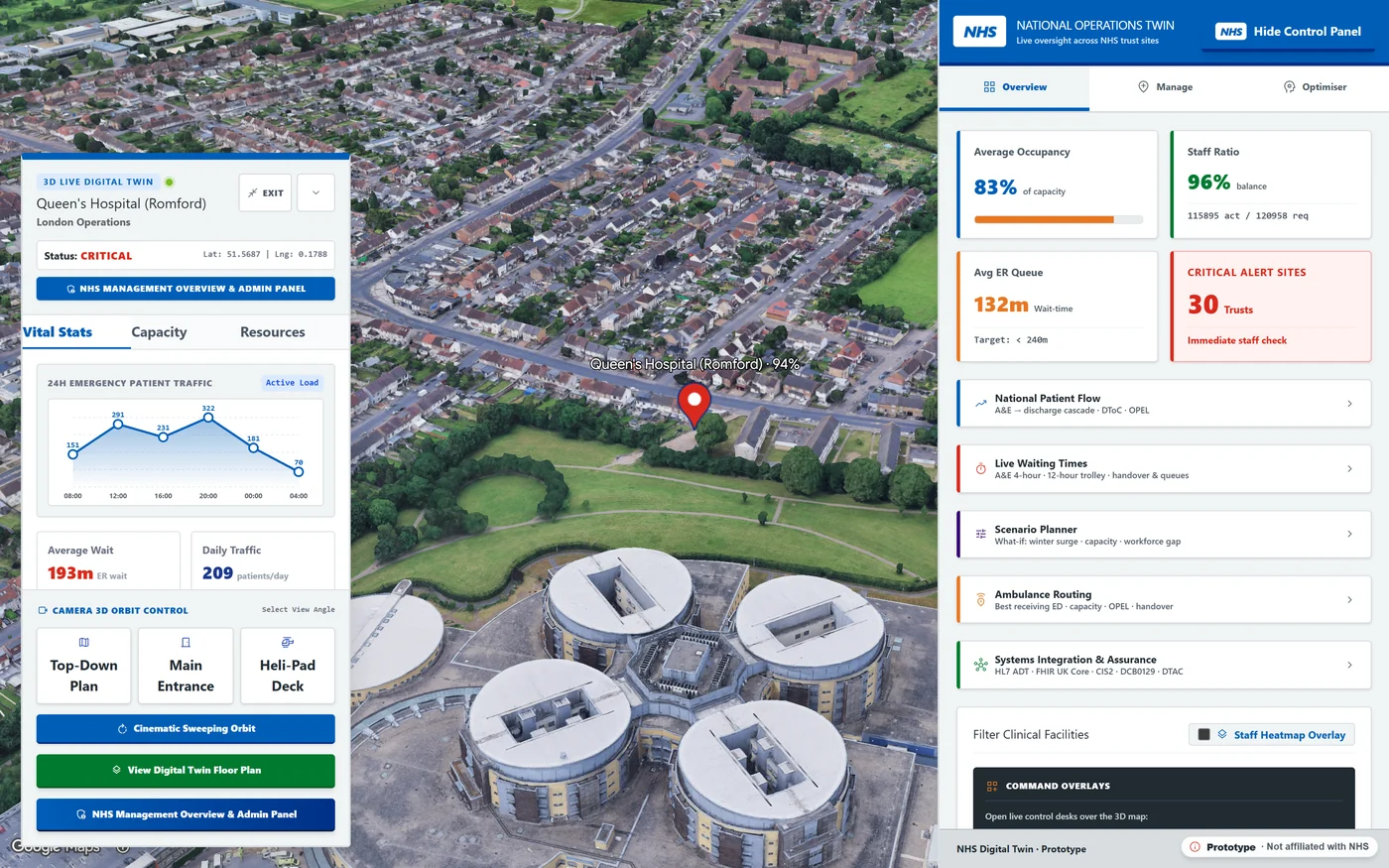
The same logic applies to planning. The hardest thing to ask a dashboard is a question about a future that has not happened yet: what does a winter surge, a flu wave or a major incident do to occupancy, to the four-hour standard, and to the staffing gap? A scenario layer that re-runs the same model as the live view lets someone rehearse a decision before committing to it — and, importantly, can never quietly disagree with the operational picture it sits beside.
What to prototype first.
Resist the instinct to model everything. A first build should prove one decision end to end and be honest about what is real.
- Name the decision and the person. Not "visibility across the estate" — something closer to "which site should the on-call director ring first, and why".
- Get location right early. A twin that flies you to the wrong building is never trusted again, and hand-maintained coordinates for a large estate drift out of date the moment they are written. Resolve sites against an authoritative source instead.
- Use modelled data, but make the behaviour real. Nobody expects live feeds in a prototype. They do expect the model to hold together and to react correctly when something changes.
- Answer "how would this connect?" on day one. In healthcare this is the first question a technical buyer asks, not the last. Being able to point at the interfaces a production deployment would use — admission and discharge messaging, a national record lookup, staff identity — turns a demo into a proposal.
- Say what it is not. A prototype that clearly states it is simulated and unaffiliated is easier to show widely, not harder.
That last point matters more than it sounds. Clinical software carries real assurance obligations — clinical risk management under DCB0129 and DCB0160, the Digital Technology Assessment Criteria, and the Data Security and Protection Toolkit. A prototype does not need certification, but it should know these exist and be built so the path to them is short rather than a rewrite.
What this means for a buyer.
Start with the business decision, audience, and evidence the project must produce. Simam Digital can turn that into a focused discovery, prototype, MVP, or production roadmap across AI applications, SaaS platforms, digital twins, real-time 3D, XR, and interactive systems.